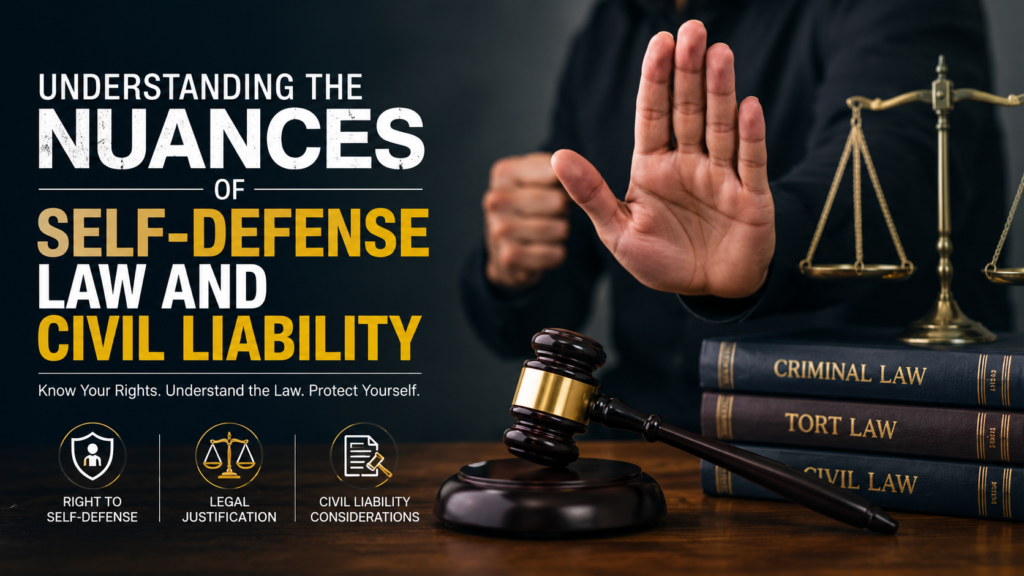
Most people who carry a firearm think carefully about the moment they might have to use it. Few think carefully about what happens in the hours, months, and years after. A self-defense incident doesn’t end when the physical danger does – it often marks the start of a second confrontation, this one fought in courtrooms and mediated by people who weren’t there.
The Double Jeopardy Nobody Warns You About
Being acquitted in a criminal court of law does not mean that you are off the hook. The individual who assaulted you or their family could bring about a civil case no matter what decision the criminal jury came to. This holds even truer when the rules and the standard for the judge and jury are taken into consideration. Criminal cases require the prosecutor to prove that the defendant is guilty beyond a reasonable doubt. Meanwhile, a civil plaintiff only needs to prove that the defendant is more likely guilty, which could lead to your actions being called into question. And when faced with the weight of the victim’s death it could be considered they were wrong.
This happens more than you think. Someone is acquitted of criminal charges after using force in a documented self-defense situation but upon applying to the estate of the attackers are ordered to pay a high sum. Your criminal judgment will not be applied to the civil court – after all, you are just protecting yourself.
The Reasonable Person Standard and Why It’s Harder Than It Sounds
Jurors determine if your decisions and actions were reasonable given the situation, your training, knowledge, and the circumstances you found yourself in. Was your fear of death or great bodily harm based on a reasonable belief that you were in imminent danger of death or great bodily harm? Juries decide how well you articulated that you had good reason to be scared (if you did). They’re not looking to see if you were scared, but if you had a good reason to be.
Lastly, there’s no magical shield that protects the right person except your behavior, decisions, actions, performance, and reputation. These eight things consistently win as your best defense in court. If they can make the people on that jury believe you’re one of the good guys, morally, ethically, and consistently do the right thing, you’ll walk free every time.
State Law Is Not Uniform and The Gap Matters
Stand your ground or duty to retreat laws significantly shape your legal exposure. Stand your ground first captured national attention after the killing of Trayvon Martin in Florida. The laws remove any requirement to attempt escape before resorting to force. As long as you’re someplace you have a legal right to be, you can stand your ground and fight back.
The castle doctrine offers similar recourse when you’re in your home, vehicle, or workplace. But even in states that extend these protection factors across additional spaces – on the street, in your car, at work, and other locations – you can still face civil litigation.
This is where proactive preparation matters. Understanding constitutional protections around the Right to Bear arms is the starting point, but it doesn’t cover the procedural and financial realities that follow an incident. Communities and states have taken varied approaches, with some putting provisions in place to protect someone from being sued civilly if their use of force was justified and others allowing the civil case to proceed regardless of criminal resolution.
The Financial Reality Of A Justified Shooting
Even if you did everything right, followed the law, and your self-defense was appropriate, you could still face significant financial risk. Complicated self-defense cases where expert witnesses need to testify can rack up $50,000 to $100,000 or more in legal bills before you even get to trial. That’s not an outside number. That’s what it costs to mount an effective defense when you need expert witnesses and potentially forensic reconstruction along with an attorney who understands self-defense law.
We put the attorney retainer figures, expert witness fees, and forensic mapping costs as standard line items in a self-defense case where the defense is in the right. The problem is that most people aren’t ready to pay those costs out of pocket – even for a legal self-defense case. An affirmative defense case has to prove the self-defense took place. This costs money no matter what the outcome is going to be.
Preparing For Both Confrontations
The divide between being “prepared to defend yourself physically” and “prepared for the legal aftermath” is the weakest point in the self-defense practices of most responsibly armed Americans. The precise details of each state’s statutes can be the difference between your freedom and jail. And they’re just the beginning. The armed citizen doesn’t just need to know when he might be criminally liable. He needs to know how to prove he isn’t civilly liable either.
Legal protection isn’t only about staying out of prison. It’s about protecting your financial position, your professional reputation, and your ability to continue living the way you’ve built. The people who come out of self-defense incidents with the least damage are rarely the ones who were most tactically ready. They’re the ones who took the legal side as seriously as everything else.