A single wabi-sabi painting given room to breathe – the negative space on the wall is as important as the work itself
There’s a strange pressure in decorating a home. The mood boards are immaculate. The finishes are coordinated. The wall art is framed just so. And somehow it all feels a little lifeless.
Wabi-sabi is the 500-year-old Japanese philosophy that explains why. It holds that beauty lives in imperfection, in wear, in things that look like they’ve actually been used and loved. Where Western design has long chased polish, wabi-sabi asks what we lose in that pursuit. The answer, it turns out, is quite a lot.
Wabi-sabi painting is having a genuine cultural moment right now, and it’s not hard to see why. Original handmade art that carries visible marks of the human hand that made it is increasingly appealing to people who’ve had enough of perfection.
What Wabi-Sabi Actually Means (and Where It Comes From)
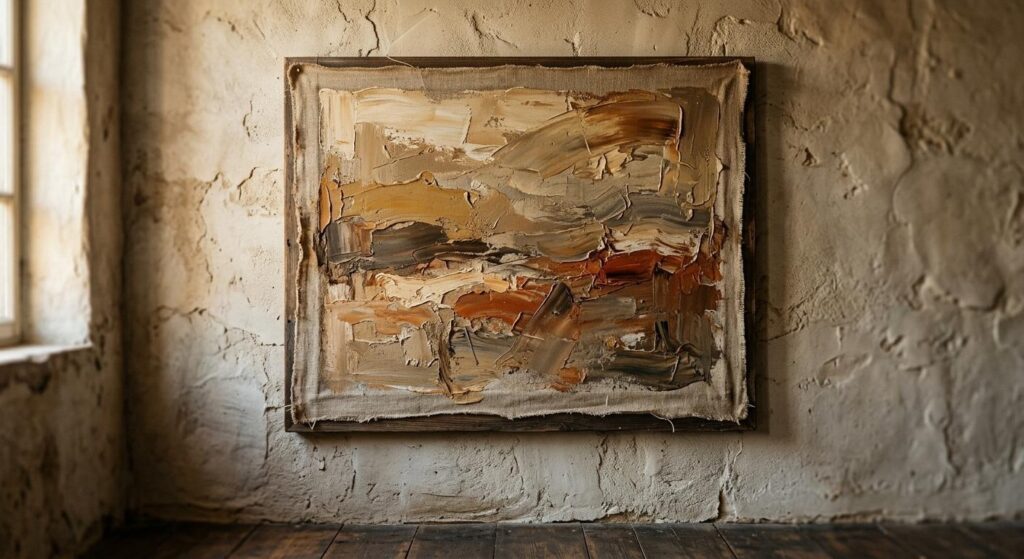
A wabi-sabi oil painting on textured canvas, with earthy tones and intentional imperfection as its defining qualities
The word is actually two concepts fused together. Wabi (侘) is about simplicity and restraint – finding beauty in the sparse, the quiet, the unadorned. Sabi (寂) is about time: the particular loveliness that objects acquire through age, wear, and the slow accumulation of use. Put them together and you get a worldview that sees a cracked tea bowl as more beautiful than a flawless one.
The philosophy has deep roots in Zen Buddhism and was formalized through Japan’s tea ceremony tradition in the 15th century. The influential tea master Sen no Rikyū rejected the elaborate Chinese ceramics that were fashionable at the time, choosing instead simple, irregular Japanese ware. A lumpy, handmade clay vessel was more honest than a gilded import, and honesty, to Rikyū, was the point.
That same commitment to honesty is what distinguishes authentic wabi-sabi painting from the kind of generic abstract art that gets mass-produced for chain furniture stores. A wabi-sabi painting carries the marks of how it was made – the palette knife stroke that wasn’t smoothed out, the raw edge of the canvas, the color that dried darker than intended. Those aren’t mistakes. They’re the record of a real person making something real.
According to EBSCO Research Starters (Ungvarsky, 2025), wabi-sabi also resists the idea that a work of art must be “finished” in any conventional sense. Incompleteness is part of the aesthetic. There’s almost always something left unresolved in the composition, a corner that fades into bare ground, a shape that doesn’t quite close – and that openness draws the viewer in rather than shutting them out.
What Wabi-Sabi Painting Actually Looks Like
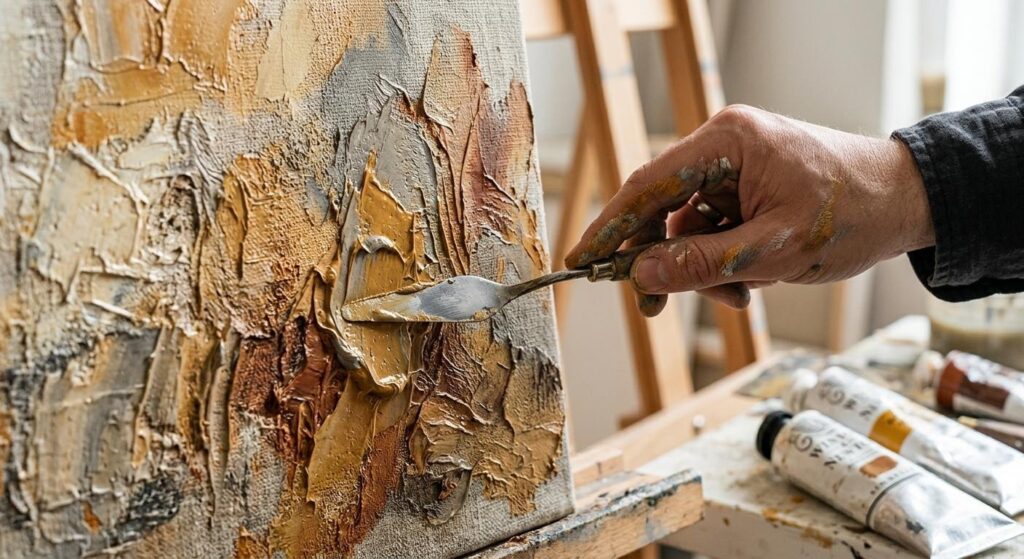
The act of creating wabi-sabi art is itself a meditation – imperfection is not a flaw but the point
The visual vocabulary of wabi-sabi painting is specific enough that you’ll recognize it once you know what you’re looking for. Muted earth tones dominate: ochre, umber, sandy beige, weathered grey, faded moss. These aren’t muted by accident – they’re the colors of things that have been subject to time. Bright saturated colors announce themselves; wabi-sabi colors hold back.
Texture is central. Many wabi-sabi artists work with cold wax medium, palette knives, or rough fabric that leaves physical relief in the paint surface. The result is a painting you could almost feel if you ran a hand across it – layered and uneven in a way that a printed reproduction will never capture. This is exactly what the philosophy demands: the surface irregularity is the statement.
Composition in wabi-sabi painting leans on the Japanese concept of “ma” – the productive use of empty space. A good wabi-sabi painting gives negative space a role equal to any mark. That’s why these works often feel calming in a way that busy, heavily worked paintings don’t. The eye is given somewhere to rest.
This is also what distinguishes wabi-sabi painting from generic abstract art. It’s not random mark-making. Every decision relates to the philosophy underneath it, and that philosophy is about restraint, acceptance, and presence. As EFindAnything explores in its piece on how art communicates through texture and form, the way a surface is built up or stripped back carries meaning that images alone can’t – and wabi-sabi painting is one of the clearest examples of that.
Why Wabi-Sabi Is Having a Moment Right Now
The numbers are striking. A February 2026 report by Consainsights estimates the wabi-sabi home decor market at $1.50 billion in 2024, projecting it to reach $2.57 billion by 2033 at a compound annual growth rate of 6.0%. That’s not a niche trend working its way through design blogs – it’s a measurable shift in how people want their homes to feel.
Michaels’ 2026 Creativity Trend Report, cited by Apartment Therapy, identifies wabi-sabi as one of the biggest creative aesthetics of the year, particularly in DIY home decorating. And Depositphotos’ Creative Trends 2025 report, based on analysis of over 41 million clients and a 300-million-asset library, named wabi-sabi as one of seven creative trends shaping the year. Ez Blaine, Chief Creative Officer at Huge (USA), called it a tool for conveying “tranquility and optimism.”
The cultural driver here isn’t hard to identify. People are tired of environments that demand attention – social feeds, screens, curated grids of impossibly perfect rooms. There’s a growing appetite for things that feel handmade, that carry some visible history, that don’t perform at you. A wabi-sabi painting on the wall doesn’t try to impress. It just is.
There’s a parallel trend in the broader art market worth noting. Art Basel and UBS reported in their Global Art Market Report that the art market totalled $57.5 billion in 2024, with growing demand for accessibly priced original works – the exact segment where wabi-sabi painting sits. For buyers who want something authentic rather than a mass-produced reproduction, original wabi-sabi work is increasingly available at prices that don’t require auction-house access.
HomiDecor’s analysis of 2025 interior design trends connects this shift directly to mental well-being, framing wabi-sabi as a grounding aesthetic that counteracts the overstimulation of modern life – a point worth returning to.
The Mindfulness Connection: What a Wabi-Sabi Painting Does for a Room
Decorating advice often treats art as finishing. You furnish the room, then you put something on the wall so it doesn’t look bare. Wabi-sabi flips that logic. The painting isn’t there to complete the room – it’s there to slow the room down.
There’s real substance behind this. Cluttered or visually busy environments increase cognitive load – a finding from a 2011 Princeton Neuroscience Institute study published in the Journal of Neuroscience. A room with a single intentional focal point – one painting with room to breathe around it – is genuinely easier to be in. You don’t have to process competing signals. The eye settles.
What wabi-sabi adds to that is a philosophical layer. When you choose a piece that embodies impermanence, acceptance, and the beauty of the unfinished, you’re not just decorating. You’re putting a daily reminder in your line of sight. The cracked glaze on a Rikyū tea bowl was supposed to prompt reflection on the nature of things. A wabi-sabi painting on your living room wall works the same way at a smaller scale – it’s a cue to stop, look, and let something be less than perfect.
This is why the philosophy fits so naturally alongside the broader movement toward intentional living. EFindAnything’s piece on the philosophy of living with less makes the case for simplification as a conscious choice, not just an aesthetic one. Wabi-sabi and minimalism aren’t the same thing – minimalism is often about clean surfaces and empty space for its own sake, while wabi-sabi embraces wear and incompleteness – but they share a commitment to choosing what you keep and why.
Choosing Wabi-Sabi Art for Your Home
Knowing what wabi-sabi painting is doesn’t automatically make choosing one easy. Here’s what to actually look for.
Start with handmade origin. A print of a wabi-sabi painting largely misses the point. The philosophy centers on things shaped by human hands and time, and a printed reproduction is neither. You want to see the texture, the variation, the marks that couldn’t have been planned. Original work is the goal.
Then look for visible surface texture. A painting that looks flat in photographs probably is flat. Wabi-sabi work tends to have physical presence – ridges, layers, areas where paint has built up or been scraped back. If the artist’s process involved a palette knife, cold wax, or fabric grounds, that should be readable in the finished piece. Favor muted over saturated color, too – the palette should feel aged, as if the earth itself contributed the pigment.
How you hang it matters as much as what you buy. A wabi-sabi painting crammed between other art loses its power. The negative space around it is part of what it does. A single painting on an otherwise bare wall will do more than a gallery-wall arrangement where everything competes for attention. Size matters less than the space you give it.
The Consainsights market report notes that the segment for accessibly priced original works continues to grow, which suggests the market is responding to exactly this preference. Original wabi-sabi paintings are available across a wide price range – you don’t need to spend gallery money to find something genuine.
The tradeoff worth acknowledging: wabi-sabi art isn’t always immediately comfortable to live with. If you’re used to rooms with strong visual anchors and bold color, the restraint can feel unfamiliar at first. The impulse to add more – another painting, a busier rug – is real. Give it a few weeks before you decide.
Imperfection Is the Point
The case for wabi-sabi painting isn’t that imperfect things are secretly perfect. It’s that the chase for perfection was always the wrong game.
A painting that shows how it was made, that carries visible marks of the hand and the process, that leaves something unresolved – that painting is asking you to meet it honestly. That’s harder than it sounds. We’re trained to want the glossy version, the finished version, the version with nothing left to question. Wabi-sabi says the thing worth keeping is the one that doesn’t pretend.
One wabi-sabi painting, given space on a wall and time in your attention, will teach you more about your own taste than a gallery wall ever could. You learn what you actually respond to, not what you’re supposed to want. That’s a trade worth making.