Walk into any traditional coworking space in Manhattan and you’ll notice something peculiar: rows of beautiful desks, premium coffee machines, and Instagram-worthy interiors, but no one is talking to each other. The workspace industry has spent billions perfecting the amenities while somehow missing the point entirely.
Traditional coworking spaces promised community but delivered isolation with better lighting. You’re paying a premium to work alone in a room full of strangers, which is essentially a fancier version of working from a coffee shop but without the good pastries.
The global coworking market is projected to grow from roughly $15 billion to over $40 billion by 2030, according to Grand View Research, yet the fundamental model hasn’t evolved much since it emerged. Remote workers, founders, and freelancers are still searching for something that actually delivers on the original promise: genuine professional connection, productivity, and flexibility that matches how they work.
The Great Coworking Paradox
The traditional coworking industry thought the problem was the space. As a result, they invested in better furniture, faster WiFi, and more trendy areas. However, they failed to see that professionals need more than just a place to sit; they also need a reason to show up.
Research from Politecnico di Milano’s study on hybrid workspaces found that work environments function best when they facilitate what scholars call “temporal in-betweenness” – those unplanned interactions that happen naturally when people work alongside each other with shared purpose. Traditional coworking models, focused on desk rental and amenity access, rarely create the conditions for these real connections.
As a result, over 50% of remote-capable employees now prefer hybrid arrangements, yet the existing system fails to support them. They are forced to choose between the isolation of home offices and the costly emptiness of traditional coworking memberships.
What Next-Generation Workspace Platforms Look Like
The shift happening now isn’t about building more spaces anymore; it’s about rethinking the entire model. Next-generation workspace platforms are emerging that flip the traditional approach on its head. Instead of managing big fixed locations with enormous costs, these booking platforms connect professionals to host venues, think of rooftop eateries, private studios, and hotels, during off-hours, allowing for workday experiences in previously existing settings.
Think of it as a marketplace that unlocks access to inspiring places to work, but with a crucial difference: community is baked into the experience, not bolted on as an afterthought. The host venue provides the space; the platform facilitates the experience that emerges from bringing the right people together.
This model solves several problems simultaneously. Independently owned venues monetize off-peak hours without additional overhead. Professionals get access to inspiring, distinctive locations at a fraction of traditional coworking costs. And because the model isn’t tied to expensive long-term real estate leases, it can scale rapidly (adding a new host venue doesn’t require millions in capital, just aligning with the venue through the platform’s standard operating framework.)
The Community-First Difference
The most significant innovation isn’t technological but philosophical. Whereas traditional coworking uses community as its marketing strategy, next-generation platforms make it the fundamental product.
Wayo, an NYC-based booking platform pioneering this model, facilitates what they call Community Workdays – curated experiences that bring small groups together to work alongside one another at host venues. Participants consistently report that these sessions create the conditions for genuine accountability partnerships rather than the anonymous desk-sharing of traditional environments.
These aren’t isolated desk-rental sessions. They’re curated experiences designed to support focus and connection where founders meet other founders, freelancers collaborate with creatives, and remote workers escape the isolation epidemic without sacrificing productivity. People report that they often leave feeling 1.5x to 2x more productive compared to working from home or traditional coworking spaces.
Why Distinctive Host Venues Change Everything
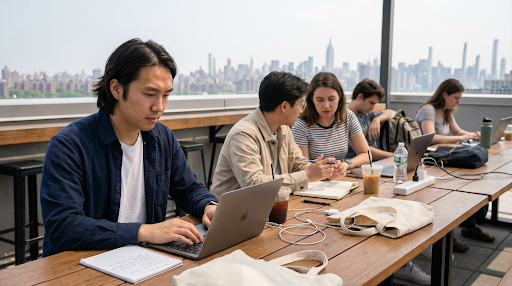
There’s a psychological principle at work here that traditional coworking misses entirely: environment shapes behavior. Working from a rooftop restaurant overlooking Manhattan triggers more creative thinking than sitting in a sterile office environment.
The academic research backs this up. Studies on “biophilic design” in workspace settings show significant improvements in both well-being and cognitive performance when workers have access to natural light, greenery, and varied environments. Traditional coworking, surrounded by commercial real estate economics, can rarely offer this variety.
The booking platform model changes the equation. When the platform enables access to dozens of independently owned host venues – each with its own character, atmosphere, and strengths – you can match your environment to your task. Need deep focus? Book a quiet private studio. Running a team brainstorm? Reserve a session at a rooftop location with city views. The right setting brings out your best work.
The Economics of Modern Workspace Models

Traditional coworking faces a fundamental challenge: the unit economics are demanding. Massive real estate investments, extensive staffing requirements, and the constant pressure to fill seats create a model that works best at scale. This is precisely why a new layer of workspace options is emerging to serve professionals who need something more flexible. Think of it as the middle ground between working from home and committing to a full-time coworking membership.
Next-generation platforms operate on entirely different economics. Without the burden of owning or leasing massive properties, they offer flexible memberships at price points that make more sense for independent professionals. At $99-$200 per month, that’s roughly $1,200-$2,400 annually for genuine community experiences – compared to $3,600-$7,200 for traditional coworking that offer little more than networking events with free drinks.
For professionals who only need workspace access one or two days per week (which describes the majority of hybrid workers), paying full-time coworking rates never made sense.
Finding Your Fit in the Evolving Workspace Landscape
If you’re evaluating modern workspace options, here’s what to consider beyond the obvious amenity checklist:
Community structure matters more than community promises. Ask how connections actually happen. Are there opportunities for meaningful interaction, or just hope that proximity creates conversation? The best platforms facilitate curated experiences designed to support real professional connection.
Flexibility should be real, not theoretical. Can you actually use the service the way you work? If you need a place to work once a week, does the pricing model support that? If your needs change every month, are you locked into rigid contracts?
Venue variety creates unexpected value. Access to multiple host venues means you can optimize your environment for different types of work. The cognitive benefits of environmental variety are real and measurable.
Outcomes trump amenities. Free coffee is nice but leaving each session more productive than you arrived, with new professional connections and genuine progress on your goals, is the standard that the best platforms are now geared to meeting.
The Future Is Already Here
The workspace industry is in the early stages of a fundamental shift. The pandemic proved that remote work is viable. So now the question becomes how to make it sustainable not only just for productivity but also for professional growth, human connection, and career development.
Traditional coworking environments solved the wrong problem. But the next generation of booking platforms is finally addressing what professionals actually need: curated experiences that make working better. For remote workers, founders, and freelancers tired of choosing between isolation and overpriced desk rental, the alternatives are finally arriving.
The question isn’t whether workspace models will evolve but how quickly you’ll find the one that works best for you. According to Gallup’s research on hybrid work preferences, the demand for flexible workspace options is only growing. So if you’re a remote worker, founder, or freelancer in NYC looking for workdays that actually deliver on the promise of community and productivity, Wayo’s Community Workdays might be worth exploring.