
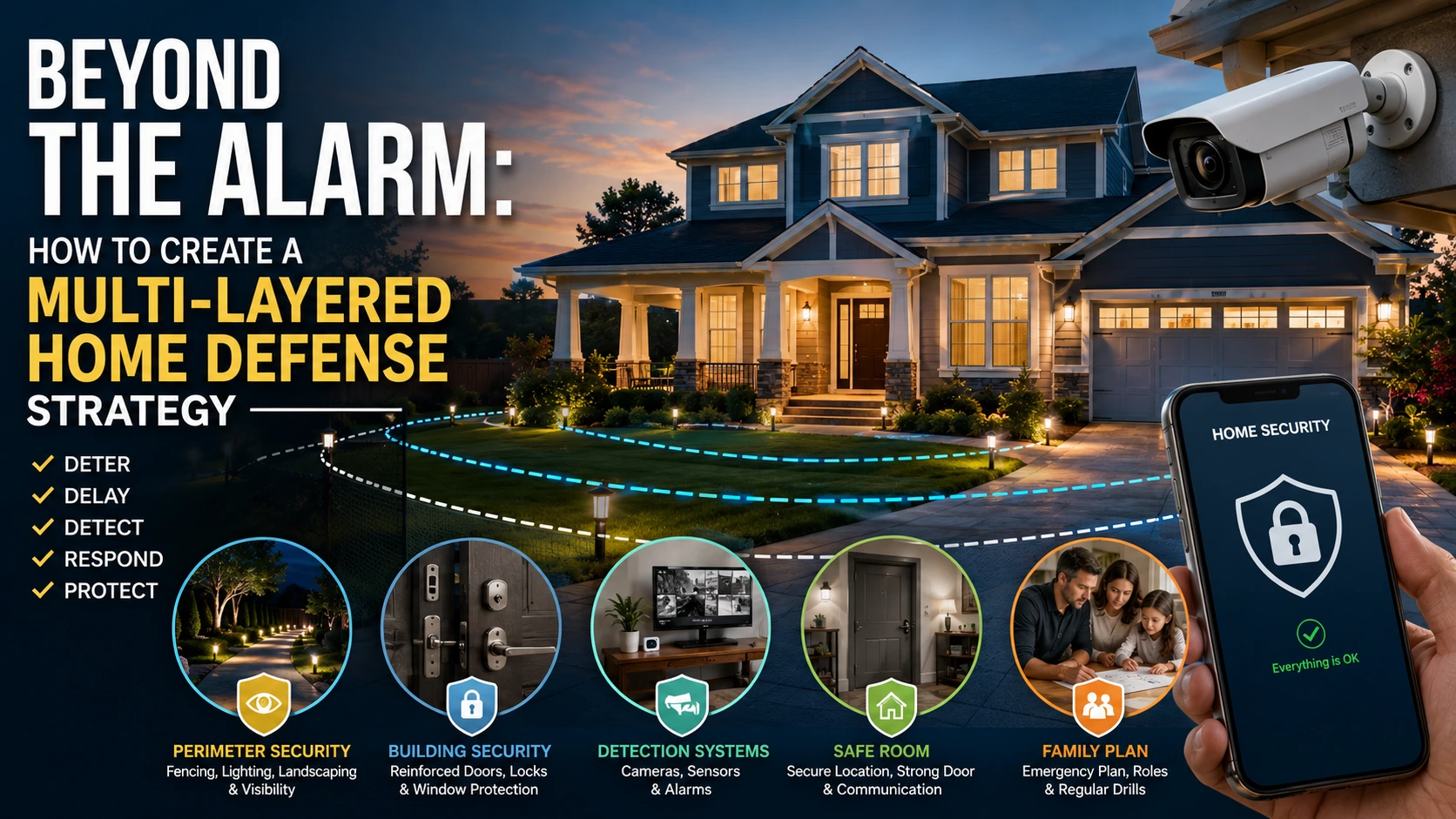
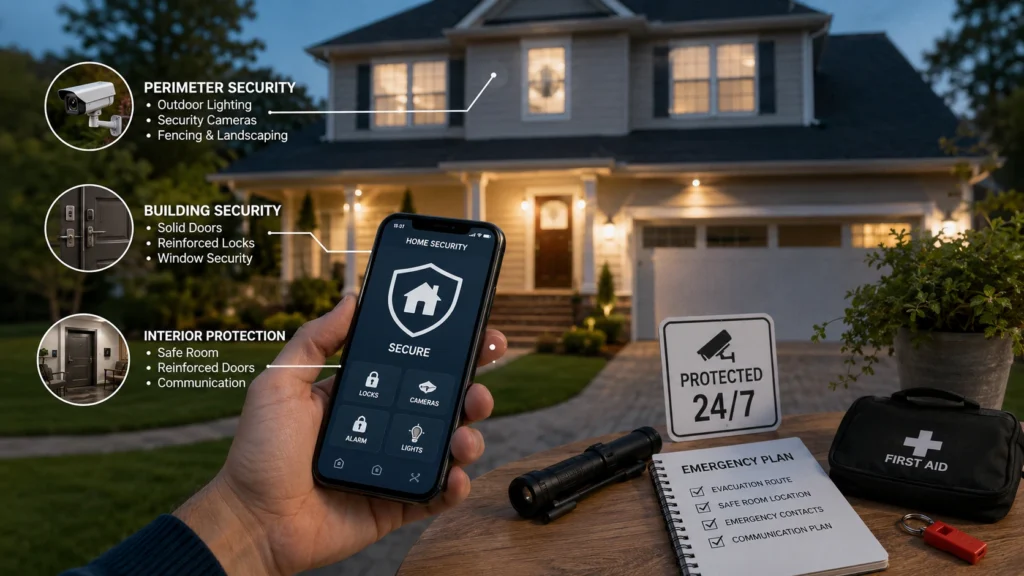
Many individuals assume that a home security system is just an alarm. While that statement is not false, it is rather incomplete and therefore dangerous. An alarm will alert you that an event is taking place – it will not, however, prevent it from happening. The true indicator of how secure your home is, is how long it would take an intruder to get from your property line to your family’s shelter. And every added layer will buy you more of those precious minutes.
The Defense-In-Depth Model For Residential Properties
The military defense-in-depth strategy was based on the idea that no single barrier holds forever, so you stack barriers. By the time an adversary breaks through one, they’ve burned time, made noise, and exposed themselves. The exact same principle applies to a house.
Imagine your house is essentially a target and you have concentric rings. The outermost ring is the property perimeter – fencing, hedges, lighting, visibility into and out of the property. The second ring is the building envelope itself – doors, windows, walls, roof. The third ring is the interior – specifically, the path from any or all compromised points in rings one and two to where your family shelters. Each ring needs to function independently. If your entire plan depends on the alarm slowing someone down at the front door, you have one ring, not three.
The object at every layer is delay. Not deterrence alone. Deterrence works on opportunists. Physical delay works on everybody.
Using Your Property As A Security Tool
CPTED stands for Crime Prevention Through Environmental Design. It’s a way of designing buildings or improving the environment to make people less likely to commit a crime. The basic idea is to remove or reduce anything that makes your house a tempting target for a thief.
For example, burglars don’t want to be seen, so cutting back bushes and hedges so they are no higher than knee height makes it harder for a thief to hide behind them while breaking into a window or door. Likewise, make sure there is nothing blocking the view of your door from the road.
Thorny plants under windows are a similarly simple and inexpensive way to put off a thief. If someone can’t stand close to your window to work on opening it, because of a rose bush or hawthorn, for example, they will have a harder time doing it silently and avoiding getting scratched.
Lighting is an easy, low cost, and very effective way to prevent a break-in. Thieves can’t work in the light, whether its a security light or a light left on, it’s not going to be their friend. Don’t aim your security light at the door, but at the path that leads up to your door. This way a thief can’t sneak up unseen.
What Alarms Actually Do (And Don’t Do)
Electronic alarm systems simply are not physical security. Alarm systems cannot physically bar access into or movement within your home or workspace. Alarm systems cannot prevent weapons brandished in their presence, nor can they immobilize an intruder. Alarm systems cannot search a facility after a breach to ensure it is once again secure. They cannot prevent a repeat break-in if an intruder “got away” clean on the first attempt.
The average response time for police to a residential alarm varies widely, but rarely falls under five minutes, and often exceeds ten. What happens between the moment a door is breached and the moment help arrives is determined entirely by your physical layers. An alarm shortens the window. It doesn’t close it.
Planning And Building Your Safe Room
The outer layers of protection – good locks, strong doors, floodlights, cameras, alarms – are there to give your safe room what it needs most: time. The longer it takes an assailant to reach your family, the more likely they are to be interrupted – whether by law enforcement, a guard dog, or someone on your family’s side with a gun.
A safe room doesn’t need to be a purpose-built concrete bunker. Choose a room with as few windows as possible, ideally an interior room with no exterior walls at all. Interior walls flanked by other rooms on both sides are harder to breach with hand tools than exterior walls. If your chosen room has a window, treat it with security film.
Communication is non-negotiable. A charged cell phone kept in the room at all times, or a landline if you still have one, means you can call emergency services without ever having to leave. Don’t rely on being able to retrieve your phone from a bedside table under pressure.
The door is where most safe room plans fall apart. Standard interior doors are hollow-core – a thin skin over a cardboard honeycomb frame. They fail in seconds. Solid-core wood doors are a step up but are still vulnerable at the frame. The most effective solution is to treat the safe room entry the way you’d treat an exterior door: reinforced frame, Grade 1 deadbolt, 3-inch strike plate screws. For anyone who wants to go further, installing a Safe Door is the definitive upgrade – a commercial-grade steel vault door turns a standard room into a space that cannot be defeated with hand tools in any practical timeframe.
Last and most crucially: a safe room only works if it is actually used. That means drilling the entire household repeatedly on what happens when the alarm sounds, and that the children know that they are to run to that one room and not come out for any reason.
Hardening Your Exterior Doors
Most forced entries come through the front door, and most people’s front doors are flimsier than they think. A deadbolt that’s ANSI Grade 1 spec is the only acceptable lock for any exterior door. Grade 1 deadbolts are tested against severe physical abuse: kick-in attacks, wrenching attacks, and picking. Anything less on an exterior facing door is just asking for it.
That lock will only be as secure as what’s anchoring it. Most residential door frames use inch-long screws that barely penetrate the door jamb. A good kick focuses that force on the strike plate and those screws holding it in place. They pop right out. Tap those screws out and replace them with 3-inch screws that shoot through the jamb and well into the structural framing behind it. That kick force is now spread out over a foot of 2×4 wood stud. The door isn’t giving way. Changing out some screws is the highest return investment in door security you can make.
Heavy-duty strike plate reinforcement with steel plates that wrap the door jamb and rise several inches above and below the latch bolt is even more extreme. Combined with proper screws, a reinforced jamb changes the math significantly for anyone attempting a kick entry.
Sliding doors and French doors are a different game. These are often the weakest point on a house. A cut-down wooden rod or steel bar dropped into the track locks a sliding door in position whether the lock is compromised or not. A secondary pin lock at top of the doorframe is a completely separate second source of resistance.
Addressing Windows
Glass is glass, delicate. But glass can be a weak entry point.
A security window film is a polyester that adheres directly to the glass’s interior surface. When the glass is broken, the film holds the splinters, keeping it together rather than falling off cleanly. There is no rapid, silent entry through a window with a security film. This requires breaking through with an extended effort, resulting in lots of noise. That’s the point. The window is not being made unbreakable; it’s being made into a time-wasting hurdle for the intruder.
Double-hung windows can be secured with heavy-duty sash locks to replace the standard flip latches that can be easily opened with lateral pressure. For windows that you rarely open, pin them in place with a steel bolt instead – drill through the sash and the frame and stick a removable pin in there.
For any window on the ground floor and any window accessible from a roof or elevated surface, use both the film and upgraded hardware. Second-floor windows that can be accessed from a tree, drain pipe, or another building are not safe to ignore.
Securing Your Smart Home Against Digital Threats
Nowadays, physical security is essentially the same problem as digital security. For instance, a home camera system that comes with a default password or an unsecured Wi-Fi network can easily provide a potential intruder with a real-time image of your property, your habits, and your daily routine – even before they’ve decided to target your neighborhood.
For every camera, router, and smart lock, change the default password shortly after installing. Your security system should utilize a separate Wi-Fi network that is different from your primary home network. Turn on two-factor authentication for any app-controlled device. Finally, verify who can access the camera feeds and remove any outdated accesses.
There’s no need to make this up. Smart cameras have previously been remotely hacked and used to spy on houses before robbers break in. All of the physical security defenses you’ve built are worthless if you don’t protect the information surrounding them.
Building A Family Emergency Protocol
The hardware is just one part of the plan. Your family needs to know what to do when something goes wrong, and they can’t be thinking it through under stress. They need to be ready to act.
Who makes the call to emergency services? Who gathers the children? Who secures the door to the safe room? In a high stress situation, a role gets executed. A decision doesn’t.
Establish a duress code. A word or phrase that sounds normal but indicates to your family member that you’re under threat. This comes up if someone is at the door coercing a conversation, or you need to communicate danger without letting on to someone standing beside you.
Conduct safe room rallying drills like you would a fire drill. Everyone in the house needs to be able to get to the safe room in the dark, in under two minutes, no talking. Once is a lesson. Repeated practice is a reflex.
The Final Layer Is Time
Every part of this strategy, including the landscaping, reinforced doors, window film, safe room, and family plan, is designed to gain time. Time for help to reach you. Time for you and your family to secure yourselves. Time that a would-be intruder, struggling against a hard clock, may determine you aren’t worth the effort.
A house that takes twelve minutes to break into as opposed to a minute and a half is not just ten minutes more secure. It is a house that most burglars will forego the second time after failing the first. The intention is not to be an invulnerable target but to be a hard enough target that you are bypassed.