
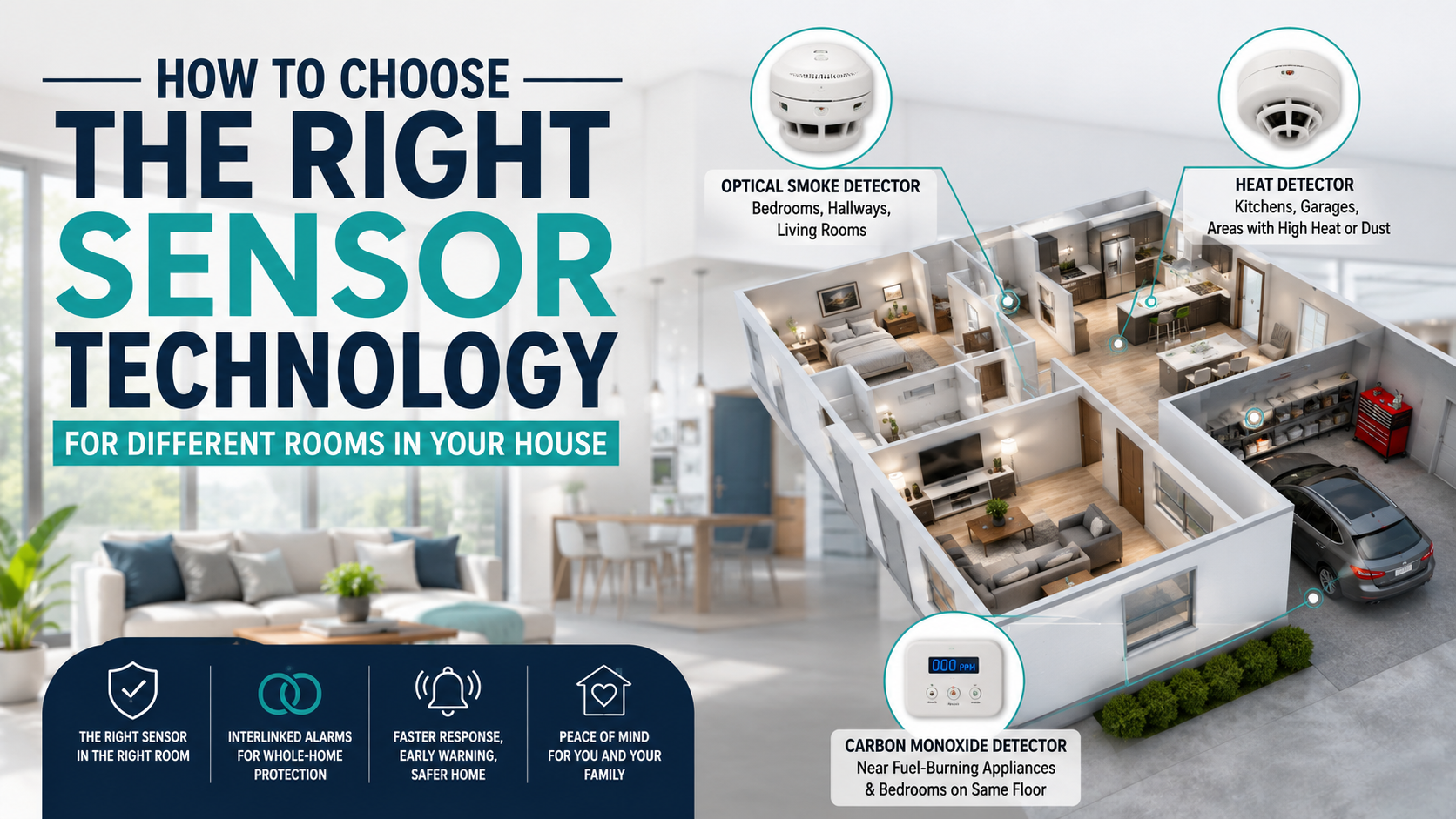
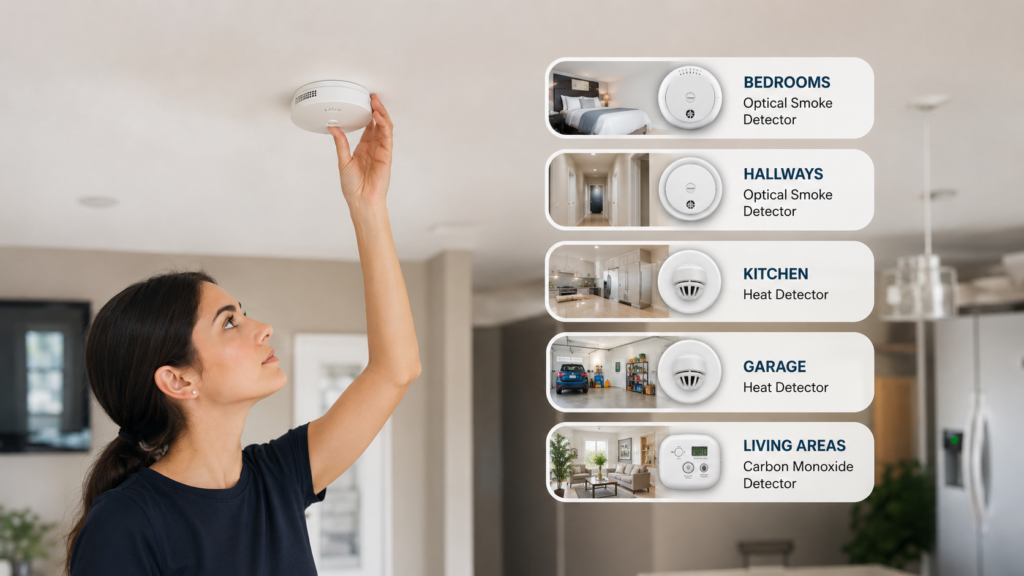
Many individuals make a purchase of a smoke alarm, slap it up on the ceiling, and then forget about it. Unfortunately, a single detector type installed in an inappropriate room can overlook an actual fire or disturb the entire house due to someone toasting bread. Different rooms produce very different air conditions, and a sensor that’s perfect for a bedroom can be entirely wrong for a kitchen.
The result, all too often, is a household with either dangerous blind spots or an alarm system everyone has learned to ignore. It’s not a complex task to get it right but you need to consider each room individually.
The Kitchen And Garage: Heat Detection, Not Smoke Detection
Standard optical smoke alarms are not suitable for use in kitchens. Cooking fumes, steam, or even a slice of toast burning under the grill will set them off. The same is true of garages, where general dust, exhaust fumes and other airborne particles generate an atmosphere that’s pretty much the antithesis of the ideal smoke test environment.
The solution in both cases is a thermistor based heat detector. These devices do not react to particles in the air at all. Instead, they respond to a rapid increase in temperature. A real fire in a garage or kitchen will cause the temperature to rise very quickly indeed, and that is what the detector ‘sees’. The dinner in the oven going up in flames won’t do that.
The distinction is important, and it’s worth emphasizing because nuisance alarms are probably the single biggest reason why people remove or disable their detectors, with all the obvious implications that has for fire safety.
Bedrooms, Hallways, And Living Rooms: Optical Sensors Do The Work
These are the places where optical smoke detection comes into its own. Optical (photoelectric) sensors function by sending a beam of infrared light across a sensing chamber – when smoke particles enter, they diffuse that light and set off the alarm. This makes them particularly responsive to slow-burning, smoldering fires, which are exactly the kind most likely to occur in bedrooms and living rooms.
Consider what is in those rooms: upholstery, bedding, curtains, electrical wiring behind walls. When these items catch fire, they tend to smolder first before flaming up. An optical sensor detects that early smoke before the fire takes hold. An ionisation sensor (an older type still common in many of the cheapest alarms) is instead tuned to fast-flaming fires and reacts far more slowly to smoldering material, i.e. the precise potential killer most likely to threaten sleeping occupants.
Hallways and landings are important in a different way – they are your escape route. A sensor here will give you early warning and ensure your escape route is in front of the fire and not blocked by it.
Interlinked Systems: The Whole House Responds At Once
Stand-alone alarms are better than nothing, but they have a real structural weakness. A fire starting in a garage or utility room at night may not be audible in an upstairs bedroom until it’s already serious. Each alarm operating in isolation is only as useful as its physical proximity to the people who need to hear it.
Wirelessly interlinked alarm systems solve this directly. When one detector triggers – whether it’s a heat alarm in the garage or a smoke alarm in the hallway – every other alarm in the network sounds simultaneously. Upgrading to this kind of system is how you build dependable household safety that actually covers the whole building, not just the room where the alarm happens to be mounted.
Multi-sensor alarms, which combine optical and thermal detection in a single unit, push this further by reducing false triggers while maintaining fast response times. These are particularly useful in transitional spaces like open-plan kitchen-diners, where the environment can shift between cooking steam and genuine fire risk.
Carbon Monoxide: Placement Is Everything
CO sensors based on electrochemical detection interact directly with carbon monoxide molecules, which makes them highly accurate and specific. But the placement of the sensor is just as important as having one in the first place.
The sensor needs to be located 1-3 meters from any fuel-burning appliance – your boiler, gas fire, wood burner, even an open fireplace. If it’s too close, the trace levels that aren’t a real danger can saturate the sensor and trigger false alarms. But if it’s at the right distance, it will detect the sort of low-level accumulation that indicates incomplete combustion and a real threat.
Carbon monoxide neither has a taste nor a smell, and it is colorless. You won’t know it’s there without a sensor. Any home with a gas boiler, stove, or fire of any description needs electrochemical CO detection in the same room as the appliance and ideally in the bedroom on the same floor.
Physical Placement: Where On The Ceiling You Mount It
The type of sensor is just one piece of the puzzle. Placing the device in the right spot on the ceiling matters, too.
Smoke and heat rise to the center of the ceiling, rather than moving toward the edges. Walls and ceiling fittings such as lights create ‘dead air’ regions in which air is still and smoke cannot easily penetrate. The rule of thumb is to fit sensors at least 300mm from any wall or ceiling fitting, as fitting them near a corner or directly adjacent to a light fitting can cause minutes of delay in detection – easily enough time for a manageable situation to become a dangerous one.
In room fires in England where smoke alarms were present but failed, 45% of the time fire products did not get to the detector. The correct sensor in the incorrect location is almost as ineffective as no sensor at all.
Matching The Upgrade To The Room
If you view home sensor installation as a blanket household upgrade – one product, one purchase, one afternoon of work – then you end up with exactly the mismatches described above. The better approach is to treat each room as its own fire and CO puzzle. Match heat detectors to kitchens and garages. Put optical sensors in every sleeping and living space.
Place electrochemical CO detection near every fuel-burning appliance. Connect everything through a wireless interlinked network. That combination does something no single alarm can: it makes the whole house respond as one system.