
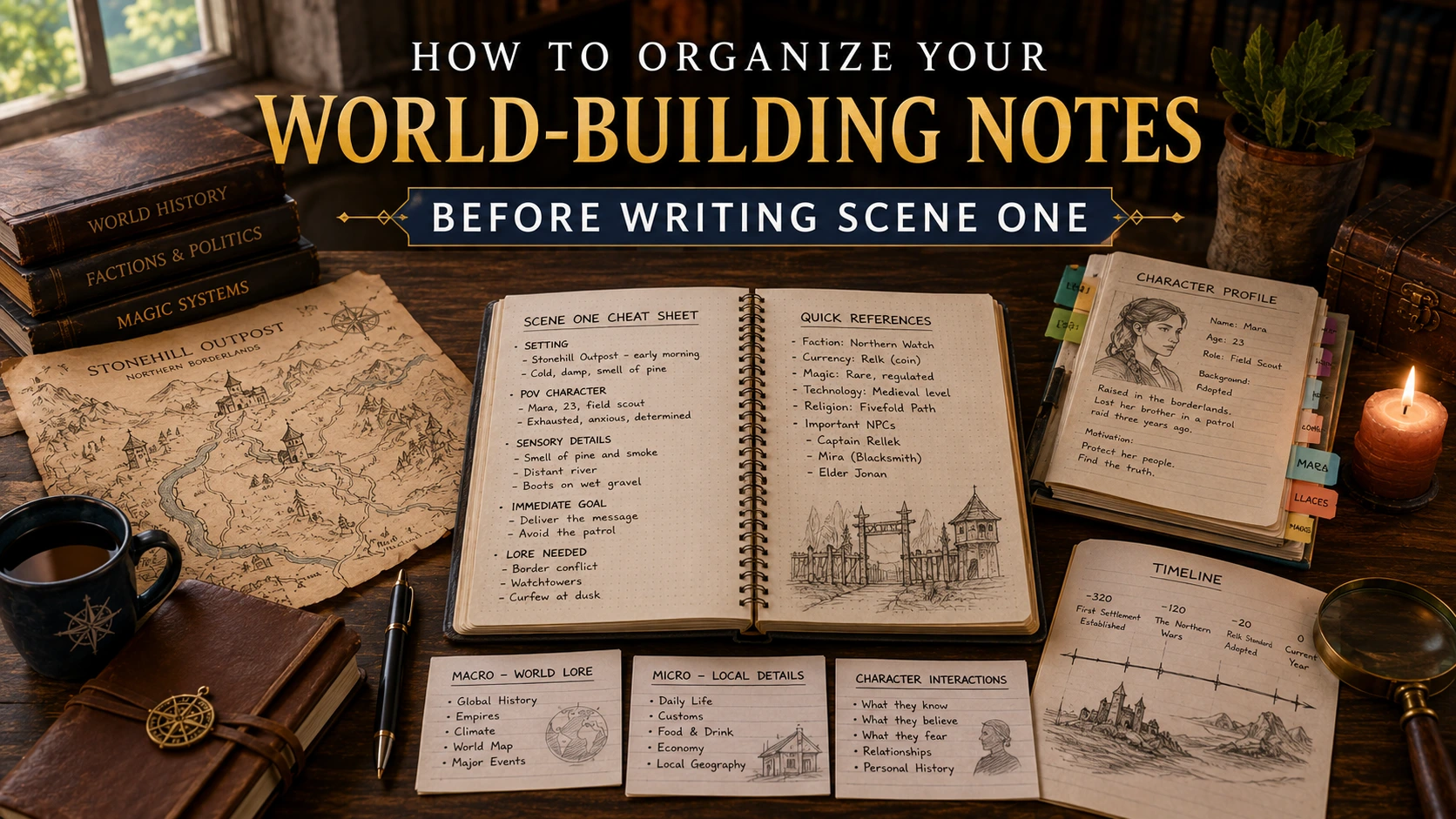
Most authors facing Scene One paralysis do not possess an insufficiency of world-building. They have a scarcity of organization. World-building exists. Characters exist. All of it lives in a half-dozen PDFs, a blog post, three open browser tabs, and a sticky note, and the work of finding what you need is enough friction to kill the urge to write before you type New. Document. A single word.
Start with the hard rules document
Before you start writing prose, put on paper the rules that govern your world. This means the limitations of your magic system, the laws of nature that are different in your world, the level of technology, anything that the logic of your story is based on.
It’s not about needing to go to extraordinary lengths to come up with something new. It’s about protecting yourself from continuity mistakes in chapter eleven that will force you to rewrite chapter four. A hard magic system with rules clearly written down – where using magic carries a cost, where there are strict limitations – safeguards you against paint-you-into-a-corner writing. A soft magic system still has a consistent application of magic, but the reader may not know (and may not need to know) all the underlying mechanics. You do.
One page is ideal. This is a constraint document. It’s not a bible. Keep your view of this flexible.
Build a cross-referenced index
Simple folder structures are not suitable for intricate worlds. A character profile that merely describes personality traits and backstory independently neglects the fact that the character grew up somewhere, was influenced by specific historical events, and holds beliefs related to certain societal conditions.
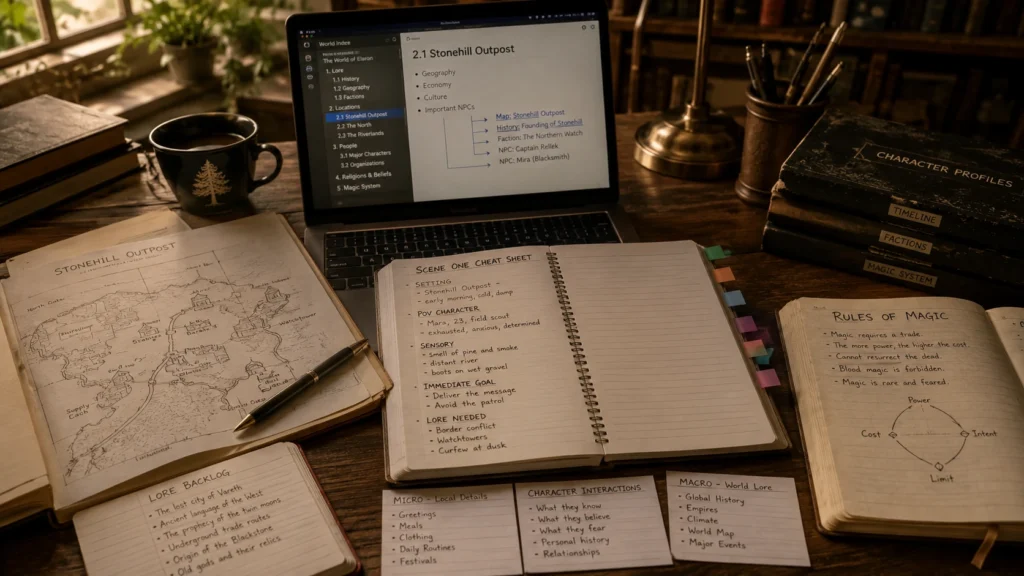
A nested, cross-referenced index interconnects those nodes. The hometown of your character leads to its geographical location and its economy. The economy, in turn, points back to the more general historical timeline. In the middle of the draft, you can verify within seconds whether your character would recognize a coin or a custom by simply following the loop instead of searching through disconnected folders.
This is where writing software for authors becomes worth it. If you transfer your notes from desktop folders to a dedicated tool like Storyloft, your character sheets, timelines, and world lore will be consolidated with your manuscript in a single place, and you can access them whenever needed.
Organize notes into three tiers
The primary mistake that world-builders make is treating all notes as equally urgent. They’re not.
Here’s a convenient way to prioritize your notes to make your worldbuilding as useful and accessible as possible.
Macro-level lore is all the stuff that shaped the world but never ever shows up directly on the page. If tier two is your story, this is your world. This is global history, and how empires rose and fell, climate, geographical mapping, broad societal structures that govern how easily people can come together in large groups to live, and so on.
Micro-level detail is where you put local customs, daily life rhythms, and what people eat and how they greet each other. This gives you the colorful textures – the smells and sounds and feel that your prose needs to place the reader there rather than just describing the scene to them.
Character-specific interactions is how your point-of-view character perceives the world they’re in. Their relationship to the lore. What they know, what they’re wrong about, what they’ve never thought to question.
The easiest way to use this method of sorting your notes is to think of your story having three separate information streams. Your reference layer. Your current scene’s descriptions. And what your character is thinking/going on about.
Isolate your Scene One cheat sheet
The “world-builder’s disease” is a term used to describe the endless planning phase before actually writing anything. This often happens when you have all the details documented but can’t access the information you need at that moment.
To avoid this, create a concise cheat sheet for your opening chapter. Only write down the details that are directly related to Scene One: the immediate physical surrounding, the sensory descriptions, the emotional state and primary motivation of your POV character, and any necessary lore to understand the situation. This cheat sheet should be about one to two pages long.
Put the rest of your world-building bible aside. This is not abandoning your research, it’s focusing on it.
Authors who get their research and world-building organized before writing have been shown to write up to 50% faster because they don’t have to interrupt the flow of their writing to look up details.
Create a lore backlog folder
There are some cool details that you simply won’t fit in the current draft. That’s okay! You came up with them for a reason, and there’s likely a place in a future book where that lore drop will fit like a glove. Or, at least it can form a seed to inspire something else you write later. No work is wasted.
Don’t delete any of it. A dedicated lore backlog folder keeps those details accessible without cluttering your working drafting space. When a piece of background lore fits naturally into a later scene, you’ll know exactly where to find it. When it never finds a home, at least it didn’t slow you down while you were writing.
From planning to page
Becoming a writer from a world-builder does not require a different mindset – it is a matter of organization. When your notes are sorted by tier, your rules are documented, your index is linked, and your Scene One cheat sheet is sitting at the top of your workspace – there’s nothing left to figure out before you start. You just start.