
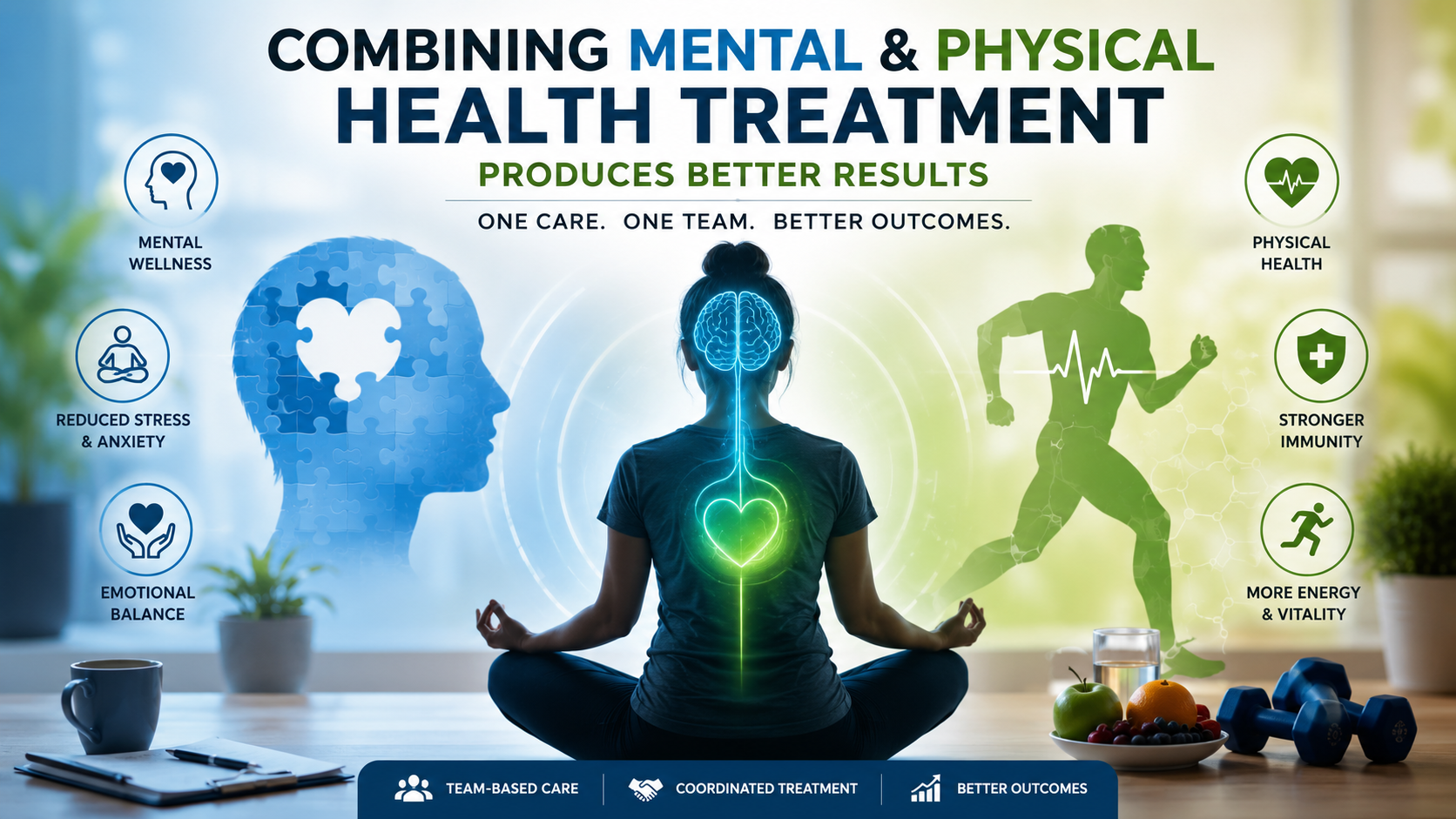
Mental health and physical health are more connected than most people realise.
Diabetes and depression used to be treated like completely separate issues. ….. Patients would see one doctor for diabetes and another doctor for depression. But studies have shown time and time again … that treating both at the same time leads to quicker patient recovery.
Here’s the reality:
- Depression makes chronic illness harder to manage
- Chronic illness raises the risk of depression
- Ignoring one makes the other worse
That’s why integrated care has become the gold standard for modern medicine.
Here’s what’s inside:
- The Mind-Body Connection You Can’t Ignore
- What Is Depression Screening in Primary Care?
- Why Integrated Treatment Produces Better Outcomes
- How Team-Based Care Actually Works
- Common Barriers That Get in the Way
The Mind-Body Connection You Can’t Ignore
Depression doesn’t just affect mood. It affects the whole body.
Depressed individuals are at higher risk for heart disease, diabetes and chronic pain. Those physical illnesses also increase the risk of depression. It’s a vicious cycle that medicine neglected for years.
Think about it:
When a person has poorly controlled diabetes and untreated depression they don’t take their medications, exercise or adhere to their diet as well. This causes their diabetes to suffer… Which causes their depression to suffer. It’s a vicious cycle.
Fixing one without fixing the other is like patching a hole while the pipe still has a leak elsewhere.
It’s no surprise that many clinics have adopted an approach that treats both issues concurrently.
What Is Depression Screening in Primary Care?
Primary care depression screening is pretty much what it sounds like. It’s a brief survey that physicians can use to identify potential depression during normal office visits.
The two most common tools are:
- PHQ-2 — a quick 2-question screener
- PHQ-9 — a longer 9-question follow-up if the PHQ-2 comes back positive
These tools take just minutes to complete… But the impact is huge.
Early detection of depression allows physicians to begin treatment earlier. The earlier treatment can begin, the better the outcome and the cheaper the care will be in the long run. This is where the collaborative care model comes into play. It elevates depression screening in primary care from one checklist to an entire treatment protocol comprised of multiple providers communicating.
But here is the tricky part…
Screening rates are far lower than they should be. Depression screening was reported to occur during just 4.1% of primary care visits from 2010 through 2018. Rates are improving, but we have a long way to go.
Why Integrated Treatment Produces Better Outcomes
There is a mountain of evidence supporting integrated care.
Why does it work? Because patients have one team looking at their overall health. Rather than visiting a series of disconnected specialists, they receive:
- A primary care doctor managing their physical health
- A behavioural health provider addressing mental health
- A care manager coordinating both sides
The results speak for themselves.
In a single large study, integrated care led to 50% of patients experiencing a 5+ point decrease in their PHQ-9 depression score. That’s a significant clinical improvement – and it didn’t require patients to step foot in another doctors’ office.
Better still, treating both together helps with:
- Taking medication as prescribed — When patients are stable mentally they are better at taking their pills
- Chronic disease management — Diabetes, heart disease, and pain conditions improve with depression treatment
- Cost savings — Fewer ER visits and fewer hospitalisations
- Patient satisfaction — One-stop care feels easier and less stigmatising
That’s a lot of wins from one simple change in how care is delivered.
How Team-Based Care Actually Works
The team-based approach is built around… well, teamwork.
Here’s the workflow most clinics follow:
- The primary care doctor screens the patient for depression using PHQ-9
- If the score is high, a care manager reaches out to the patient
- A psychiatric consultant reviews the case and recommends treatment
- The primary care doctor prescribes medication if needed
- The care manager follows up to track progress
- Treatment gets adjusted based on the patient’s PHQ-9 scores over time
Simple, right?
That’s where the magic happens. So often in traditional care, nothing happens between visits. Here, the care manager follows up — calls, texts, ensures the plan is effective.
Note: Patients seen at federally qualified health centres or community mental health centres also benefit from this model immensely because access to specialists without outside resources can be limited.
Common Barriers That Get in the Way
If integrated care is so great, why isn’t every clinic doing it?
There are a few reasons:
- Reimbursement issues — Insurance sometimes struggles to pay for team-based care
- Staffing shortages — Not every clinic has a behavioural health provider on staff
- Training gaps — Primary care physicians require additional training to feel comfortable treating depression
- Time pressure — Screening adds a few minutes to already packed visits
However, things are starting to shift. Each year, more states adopt reimbursement codes for team-based care and more providers enter into integrated networks.
The big takeaway?
The fact that these barriers exist doesn’t mean they can’t be surpassed. Clinics that embrace this model will likely reap the benefits fairly quickly in the form of healthier patients and improved financial results.
Small clinics are beginning to demonstrate this as well. You don’t need a sprawling hospital budget to make integrated care effective — just an organized workflow and a team that communicates. Even one behavioural health provider shared among a handful of clinics can dramatically improve patient outcomes.
Bringing It All Together
Integrated mental and physical health care isn’t just a “nice to have” anymore. It’s the proven method for helping patients recover — and faster and cheaper than the antiquated piecemeal model.
To quickly recap:
- Depression and chronic illness feed off each other
- Depression screening in primary care catches problems early
- Integrated care produces better outcomes across the board
- Team-based workflows are the future of medicine
- Barriers exist, but they are being knocked down every year
The proof is indisputable… Approaches that treat the whole person — mind and body together — are far more effective than those that treat each in isolation. Clinics, patients and payers are beginning to realize this. Now it’s time to ensure that this becomes standard of care.