
E Find Anything
Saturday, April 18, 2026
  • Home
  • Health & Fitness
  • Technology
  • Pets
  • Business
  • Financial Services
  • Home Products & Services
  • Other Categories
    • Cars & Other Vehicles
    • E Money
    • Education
    • Entertainment
    • Foods
    • Games
    • Lifestyle
    • Other
    • People and Society
    • Relationships
    • Spirituality
    • Travel
  • About Us
  • Contact Us
No Result
View All Result
  • Home
  • Health & Fitness
  • Technology
  • Pets
  • Business
  • Financial Services
  • Home Products & Services
  • Other Categories
    • Cars & Other Vehicles
    • E Money
    • Education
    • Entertainment
    • Foods
    • Games
    • Lifestyle
    • Other
    • People and Society
    • Relationships
    • Spirituality
    • Travel
  • About Us
  • Contact Us
No Result
View All Result
E Find Anything
No Result
View All Result
Home Health & Fitness

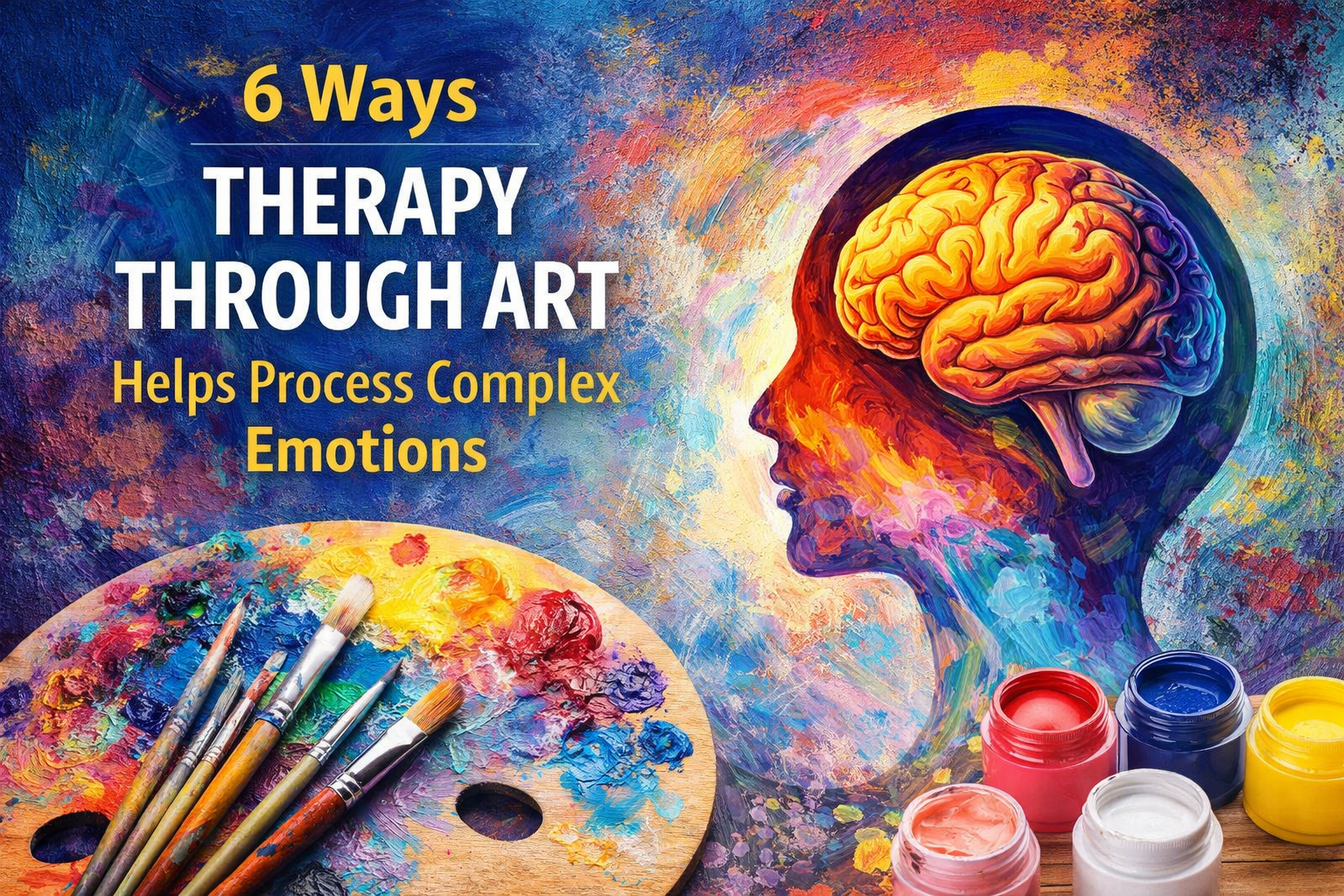
6 Ways Engaging in Therapy Through Art Helps Process Complex Emotions

Bryan Davis by Bryan Davis
March 23, 2026
in Health & Fitness
Reading Time: 4 mins read
0
0
SHARES
8
VIEWS
Share on FacebookShare on Twitter
therapy through art helps process complex emotions

Most people assume therapy means talking. Sitting across from someone, finding the right words, explaining yourself clearly enough that something shifts. But for a lot of people, that’s exactly where the process stalls. The words don’t come, or they come out wrong, or the feeling is too old and too shapeless to fit into a sentence. Engaging in therapy through art sidesteps that bottleneck entirely.

Table of Contents

Toggle
  • The verbal filter problem
  • The body processes what the mind avoids
  • Externalizing what feels internal and formless
  • Flow states and the interruption of rumination
  • A container for emotions that feel unspeakable
  • Restoring a sense of agency

The verbal filter problem

The prefrontal cortex is where we organize language and apply social editing. It’s also what kicks in when we’re asked to explain a feeling we’d rather not examine too closely. Talk therapy works through this region, which means it’s also working against our natural resistance to self-disclosure.

Art therapy doesn’t follow that route. Visual and tactile creative work activates the limbic system – the part of the brain that stores emotional memory and regulates feeling. When someone picks up a brush or presses their hands into clay, they’re not narrating an experience. They’re re-entering it, on slightly different terms. That’s not a metaphor. It’s a different neurological pathway.

This is why people often surprise themselves in art therapy. Something shows up on the page they didn’t plan to put there.

The body processes what the mind avoids

Sensory input is vital in this context for good reason. The physical pushback of clay, the pull of charcoal, the spread of watercolor beyond the line you hoped it would contain is not merely an appreciation of beauty – it’s an invitation to be here now, in your body.

In stress, the nervous system is often over-aroused. It’s difficult to ground something so abstract – an idea, a feeling – but show it a lump of clay, or ask it to concentrate on the feeling of pencil and paper, and it has no choice but to bring in some of its attention.

For grounding, during overwhelm or other emotional disturbance, sensory input is practically mandatory. And the sensory requirements of making an object by hand absolutely guarantee it. This is not an optional feature of art as therapy: sensory processing underpins the whole damn mechanism.

Skill and talent have nothing to do with it. A study published in the journal Art Therapy in 2016 revealed that after just 45 minutes of art-making, levels of the cortisol stress hormone were reduced in 75% of participants, spirited amateurs and complete rookies alike.

Externalizing what feels internal and formless

One of the more underappreciated aspects of creative therapy is what happens when something internal becomes physical. Grief, shame, rage – these exist as pressures inside the body. They’re hard to examine because they’re everywhere and nowhere at once.

When you make something that represents that feeling – even abstractly, even badly – it becomes an object. You can step back from it. You can look at it from the left and the right. You can decide to add something or cover something over. The feeling hasn’t gone anywhere, but it’s no longer inside you in the same way. That shift in relationship is what makes cognitive reframing possible, not as a mental exercise, but as a direct visual experience.

For people exploring this kind of work, finding the right environment matters as much as the process itself. Cerulean Space is one example of a space built specifically for therapeutic creative work – where the context supports the kind of vulnerability this process asks for.

Flow states and the interruption of rumination

Anxiety and depression both run on repetitive thinking. The same loops, the same catastrophic or self-critical narratives playing in the background. It’s very hard to think your way out of a thought pattern.

Creative engagement interrupts it. When a task requires enough attention that the internal monologue quiets down, that’s a flow state. It’s not escape – it’s something more useful than that. The brain is still working, but it’s working on the problem in front of it, not the ones it’s constructed.

That interruption, repeated often enough, starts to change what the brain defaults to. Neuroplasticity is the technical term. The practical result is that people report their anxiety becoming less automatic over time.

A container for emotions that feel unspeakable

Not everything we feel is socially acceptable to express. Rage at someone we love. Grief that’s gone on longer than others seem to think it should. Shame that we can’t put into words without it sounding worse than it actually is.

Art provides a container for all of it. The image holds the emotion without judgment. It doesn’t recoil. It doesn’t try to fix anything. This is where the concept of sublimation becomes genuinely practical – the pressure of something difficult gets channeled into something made, and the making is the release.

Restoring a sense of agency

Experiencing trauma, chronic stress, and hard life conditions makes us feel less in control of our lives. Engaging in artistic activities can change that. Every decision you make when creating something, like choosing a color, how hard to press the pencil, or where to put the next line, is a small but significant decision. These little decisions can build up over time and contribute to a larger one: feeling like you have control of your life.

You don’t need to be good at art for this to work. You need to be willing to make something.

Tags: art for emotional wellnessart therapy benefitscreative therapy techniquesemotional healing through artexpressive therapy methodsmental health art therapyprocess complex emotionspsychology art therapystress relief through arttherapy through art
ShareTweetPin
Previous Post

How do perfume and lip balms elevate your daily fashion style?

Next Post

How to Choose the Right Presenter for Your Next Technology Seminar

Bryan Davis

Bryan Davis

Bryan Davis is a professional writer and researcher specializing in health, wellness, pets, and technology. With years of experience producing accurate, evidence-based content, he combines thorough research with practical knowledge to provide readers with reliable guidance. Bryan is dedicated to creating trustworthy content that empowers individuals to make informed decisions about their health, lifestyle, and pets.

Related Posts

personalized wellness trends

5 Emerging Trends in Personalized Wellness for Better Vitality

by Bryan Davis
April 16, 2026
0

Many wellness programs continue to be developed based on disease symptoms. For example, when you feel tired, you may decide...

Can Lexapro Withdrawal Cause Tension Headaches

Can Lexapro Withdrawal Cause Tension Headaches? 5 Side Effects of Lexapro Withdrawal

by Bryan Davis
April 14, 2026
0

Stopping Lexapro can feel like hitting a brick wall. You've been on escitalopram for months or years to manage anxiety...

caster and pneumatic wheels for healthcare equipment

Caster and Pneumatic Wheels for Healthcare Equipment: Improving Mobility and Safety

by Bryan Davis
April 13, 2026
0

Mobility is a foundational requirement in modern healthcare environments. From hospital beds and IV stands to diagnostic machines and emergency...

new runner starter kit

The Essential Checklist for Every New Runner’s Starter Kit

by Bryan Davis
March 25, 2026
0

Stepping into running is one of the simplest ways for you to improve your fitness - and one of the...

perfume and lip balms elevate your daily fashion style

How do perfume and lip balms elevate your daily fashion style?

by Bryan Davis
March 23, 2026
0

Personal style grows stronger through small details that shape how a person feels each day. Scent choice adds a soft...

Next Post
technology seminar presenter speaking to audience at tech conference event

How to Choose the Right Presenter for Your Next Technology Seminar

4x4 upgrades including lift kit all-terrain tires skid plates and winch for weekend off-roading

Top 4x4 Upgrades to Transform Your Daily Driver for Weekend Off-Roading

Leave a Reply

Your email address will not be published. Required fields are marked *

RECOMMENDED

first guided UTV adventure tour tips

Helpful Tips to Prepare for Your First Guided UTV Adventure Tour

April 17, 2026
kayaking trip on the Shenandoah River

How to Prepare for a Fun and Comfortable Kayaking Trip on the Shenandoah River

April 17, 2026

MOST VIEWED

  • What Is VACP Treas 310

    VACP Treas 310 Meaning: VA Payment Code Explained (2026 Guide)

    0 shares
    Share 0 Tweet 0
  • Babata Namak Sinhala – Babata Lassana Namak

    7361 shares
    Share 0 Tweet 0
  • 15 Best Sites to Download Paid Android Apps for Free

    1 shares
    Share 0 Tweet 0
  • Top 5 Trends in Sunglasses for 2026

    0 shares
    Share 0 Tweet 0
  • 42 Dugg Height Life, Career, Net Worth, and More

    0 shares
    Share 0 Tweet 0

Follow Us on Social Media

efindanything-logo

This is a lifestyle blog offering an everything about Health & Fitness,Financial Services,Insurance,Travelling and more.Join us. Dive in. Improve your Life

CATEGORY

  • Art & Design (1)
  • Business (300)
  • Careers (9)
  • Cars & Other Vehicles (136)
  • Construction (5)
  • Digital Marketing (6)
  • E Money (26)
  • Education (70)
  • Engineering (1)
  • Entertainment (17)
  • Environment (1)
  • Fashion (49)
  • Financial Services (160)
  • Foods (48)
  • Games (49)
  • Gear & Equipment (2)
  • Health & Fitness (454)
  • History (3)
  • Home Products & Services (384)
  • Insurance (16)
  • Law (153)
  • Lifestyle (40)
  • Other (24)
  • Parenting (3)
  • People and Society (34)
  • Pets (1,228)
  • Political (1)
  • Psychology (2)
  • Real Estate (62)
  • Relationships (48)
  • Safety (17)
  • Spirituality (51)
  • Sports (22)
  • Technology (240)
  • Travel (65)
  • Wishes (1)

RECENT POSTS

  • Helpful Tips to Prepare for Your First Guided UTV Adventure Tour April 17, 2026
  • How to Prepare for a Fun and Comfortable Kayaking Trip on the Shenandoah River April 17, 2026
  • Jaynike vs YouTubeStorm: Which YouTube Growth Service Is Best in 2026? April 17, 2026
  • How Can You Make Your Moving Day More Organized and Stress-Free? April 17, 2026
  • TikTok Views Providers Compared: Which Platform Delivers Real Tiktok Engagement? April 16, 2026
  • Home
  • About Us
  • Contact Us
  • Privacy Policy
  • Terms & Conditions
  • Disclaimer
  • Sitemap

© 2018- 2026 E Find Anything

No Result
View All Result
  • Home
  • Health & Fitness
  • Technology
  • Pets
  • Business
  • Financial Services
  • Home Products & Services
  • Other Categories
    • Cars & Other Vehicles
    • E Money
    • Education
    • Entertainment
    • Foods
    • Games
    • Lifestyle
    • Other
    • People and Society
    • Relationships
    • Spirituality
    • Travel
  • About Us
  • Contact Us

© 2018- 2026 E Find Anything

Go to mobile version