
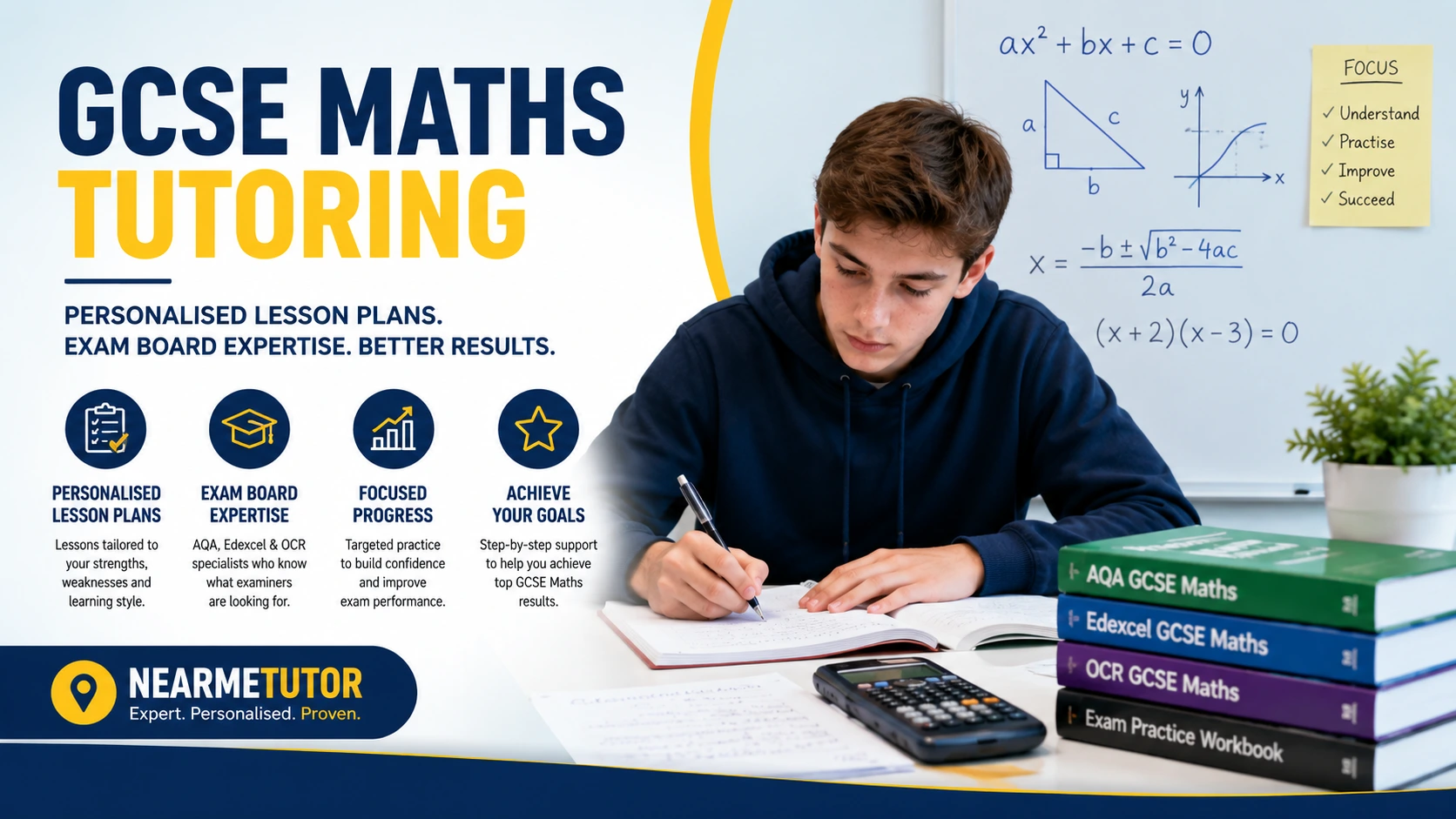

Strong GCSE Maths results rarely come from doing more worksheets or simply attending extra lessons. They come from studying the right topics, in the right order, with teaching that matches both the student’s current ability and the requirements of their exam board. Every student has different strengths, misconceptions, and learning speeds, so a one-size-fits-all approach often leaves important gaps unaddressed.
When parents begin looking for a NearMeTutor, they often hear phrases like “personalised lessons” and “exam board expertise.” Those terms sound reassuring, but they can mean very different things in practice. Understanding what effective lesson planning actually involves helps families choose tutoring that supports measurable progress rather than generic revision.
How Personalised GCSE Maths Lesson Plans Are Built
A tailored lesson plan begins with identifying what the student already understands instead of assuming they need to relearn the entire syllabus. Experienced tutors usually carry out a diagnostic assessment before teaching begins, allowing each lesson to focus on genuine knowledge gaps rather than repeating familiar topics.
A personalised plan commonly includes:
- A diagnostic review to identify strengths and weaker areas.
- Topic prioritisation based on exam weighting and current performance.
- Regular review sessions to reinforce previously learned concepts.
- Adjustments as the student’s confidence and accuracy improve.
Rather than following textbook chapters in order, lessons evolve according to ongoing progress. A student struggling with algebra may temporarily pause geometry work until the necessary foundations are secure.
Why Exam Board Expertise Makes a Real Difference
Although GCSE Maths covers similar mathematical concepts across England, AQA, Edexcel, and OCR assess them differently through question style, mark schemes, and problem-solving expectations. Tutors familiar with these specifications can prepare students for the way questions are actually presented in exams rather than teaching mathematics in isolation.
Key differences tutors account for include:
- Question wording and multi-step problem structures.
- Mark allocation for working out and reasoning.
- Calculator and non-calculator paper strategies.
- Common mistakes that lose method marks.
This knowledge helps students avoid unnecessary errors even when they understand the underlying mathematics.
| Lesson Planning Element | Generic Tutoring | Personalised GCSE Tutoring |
| Starting point | Fixed syllabus | Diagnostic assessment |
| Lesson order | Same for every student | Adjusted to learning gaps |
| Practice questions | Mixed exercises | Exam board-specific questions |
| Progress checks | Occasional | Reviewed after every topic |
| Exam preparation | General revision | Targeted past paper practice |
What Happens During a Well-Structured Tutoring Session
An effective lesson is carefully paced. It balances explanation, guided practice, independent problem-solving, and feedback instead of relying on continuous instruction.
A typical session may include:
- A short review of previous learning.
- Teaching one focused concept with worked examples.
- Independent exam-style questions.
- Reflection on mistakes and homework planning.
Many experienced tutors also incorporate past paper practice, mathematical reasoning, problem-solving skills, and revision planning throughout the learning process instead of leaving them until the weeks before exams.
Tracking Progress Beyond Test Scores
Improvement is not measured only through mock exam marks. Consistent tutoring also looks at how students approach unfamiliar questions, explain their reasoning, and manage exam timing.
Useful indicators include:
- Fewer repeated mistakes across topics.
- Improved confidence tackling multi-step questions.
- Faster recall of key mathematical methods.
- Better organisation during timed practice papers.
These smaller improvements often appear before noticeable grade increases and help build long-term confidence.
Choosing a Tutor Who Offers Genuine Personalisation
Not every tutor who advertises personalised teaching follows a structured planning process. Asking the right questions before starting lessons can reveal whether tutoring will truly meet a student’s needs.
Consider asking whether the tutor:
- Begins with a diagnostic assessment.
- Adapts lessons for AQA, Edexcel, or OCR specifications.
- Uses progress tracking rather than occasional tests.
- Provides targeted homework based on previous lessons.
A NearMeTutor who combines subject expertise with thoughtful lesson planning is more likely to deliver focused support than someone relying solely on standard revision materials.
Rather than covering every topic equally, effective tutoring concentrates effort where it produces the greatest improvement. That targeted approach helps students make better use of every lesson and enter exams with greater confidence.
Frequently Asked Questions
1. How often should a personalised GCSE Maths lesson plan be updated?
Most tutors review it every few weeks or after major assessments to reflect new strengths and areas needing attention.
2. Can one lesson plan work for both Foundation and Higher Tier students?
No. While some topics overlap, Higher Tier includes additional content and more demanding problem-solving questions.
3. Why should tutoring match my child’s exam board?
Each exam board uses different question styles and mark schemes, so practising the correct format helps students perform more confidently.
4. Do personalised lessons focus only on weak topics?
Not entirely. They strengthen weaker areas while also revisiting stronger topics to maintain accuracy and retention.
5. How can a NearMe Tutor measure improvement between lessons?
Progress can be tracked through topic assessments, error analysis, timed questions, homework performance, and increasingly accurate exam-style responses.