
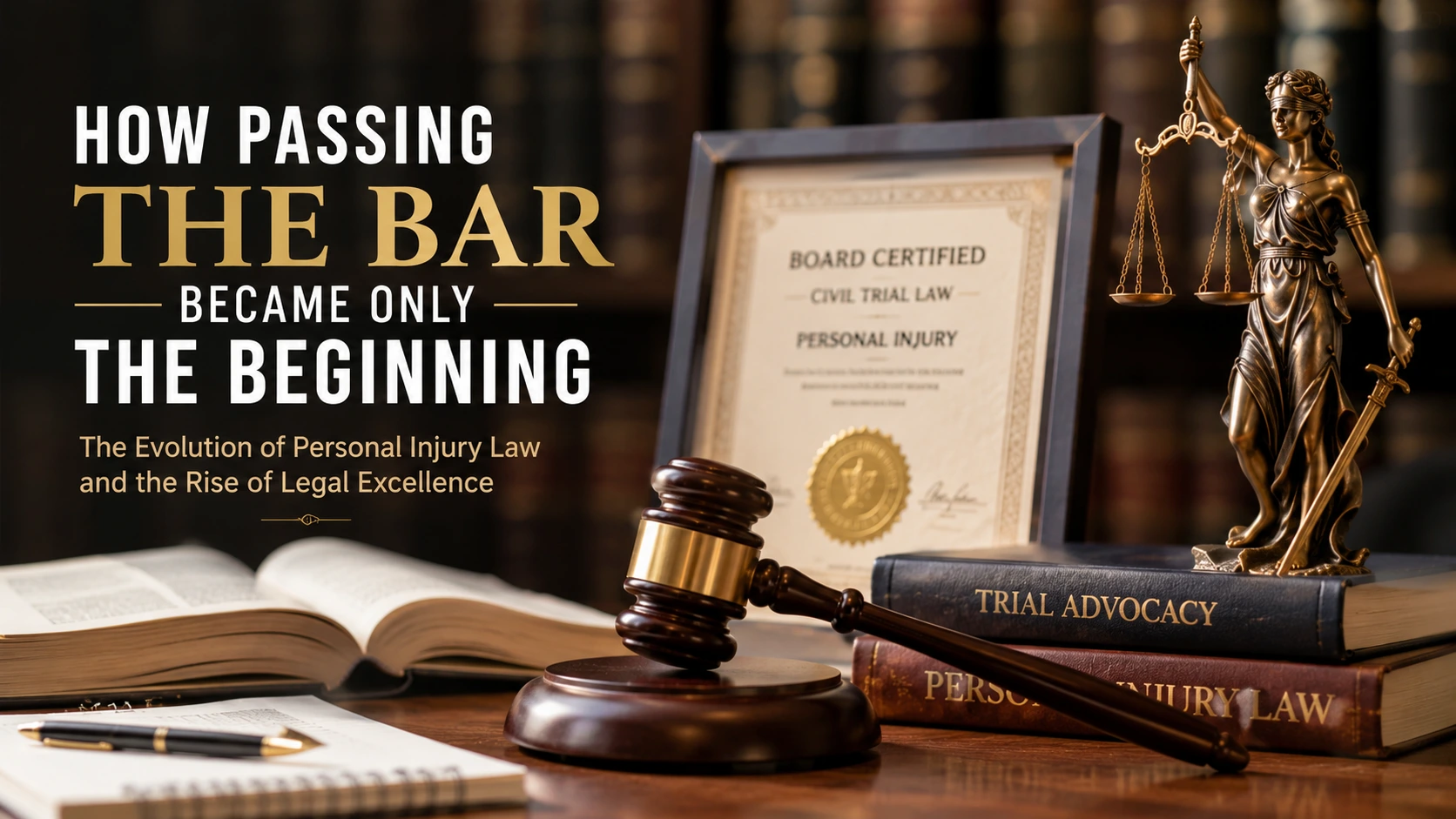

Personal injury law did not always look the way it does today. A century ago, the field barely existed as a distinct specialty. Lawyers who represented injured people were often generalists who took whatever cases came through the door, and the profession offered little in the way of formal recognition for those who focused on injury claims. Over the following decades, that changed dramatically. As courts, insurance companies, and client expectations grew more sophisticated, the profession built an entire architecture of credentials, continuing education, and peer recognition designed to separate competent injury lawyers from the rest. Understanding how that architecture came to be says a great deal about why the field commands the trust it does now.
The Early Years of an Unstructured Practice
In the first half of the twentieth century, injury law was largely a byproduct of general civil practice. There were no formal certifications for trial specialization, and law schools rarely offered dedicated coursework in tort litigation. A lawyer who handled a workplace injury one week might draft a will the next. This generalist model worked reasonably well when injury claims were simple and insurance policies were straightforward, but as automobiles became common and workplaces grew more mechanized, the volume and complexity of injury cases increased. Courts began seeing more disputes over liability, damages, and insurance coverage, and it became clear that a lawyer’s ability to navigate this terrain effectively required more than a general legal education. The seeds of specialization were planted here, though it would take several more decades for formal standards to catch up with the reality of the work.
The Rise of Specialty Bar Associations
The mid-twentieth century brought the first organized push toward recognizing injury law as its own discipline. Trial lawyer associations formed at both the state and national level, giving injury attorneys a professional home separate from the broader bar. These organizations did more than provide networking opportunities. They established codes of practice, encouraged the sharing of trial strategy, and eventually began pushing state bars to recognize personal injury and civil trial advocacy as areas worthy of formal certification. This mattered because certification created an external benchmark. Rather than relying solely on reputation or word of mouth, clients and referring attorneys could point to a credential that signified a lawyer had met specific standards around trial experience, continuing education, and peer evaluation. The Bureau of Labor Statistics tracks employment trends across the legal profession broadly, and the growth of specialized bar credentials during this period reflected a field that was maturing into a distinct professional track rather than remaining a subset of general practice.
Board Certification and the Modern Credentialing System
By the latter part of the twentieth century, most states had established some form of board certification for civil trial or personal injury law. To earn this designation, an attorney typically had to demonstrate a substantial volume of trial experience, pass a rigorous written examination, complete continuing legal education hours specific to injury litigation, and receive favorable evaluations from judges and opposing counsel who had observed their work firsthand. This system created a meaningful filter. Passing the bar exam qualified someone to practice law generally, but board certification signaled something more specific: sustained, verified competence in the courtroom handling the kinds of claims that arise from collisions, workplace incidents, and premises liability disputes. Peer review rating systems developed alongside these certifications, giving clients another layer of independently verified information about an attorney’s reputation among colleagues and the judiciary. Together, these mechanisms transformed injury law from a field where credentials were largely informal into one with a structured, verifiable hierarchy of expertise.
How Standards Shaped the Client Experience
The practical effect of this evolution is visible in how injury claims are handled today. Someone searching for a car accident lawyer now encounters a profession with clear markers of quality, from state bar certification to malpractice insurance requirements to continuing education mandates that keep attorneys current on evolving case law and insurance practices. This did not happen by accident. Every layer of credentialing was built in response to a real need: clients dealing with injury and loss needed a reliable way to identify attorneys capable of managing complex litigation, medical documentation, and negotiations with insurance carriers. The standards that emerged did not just protect consumers. They also elevated the profession itself, giving skilled trial lawyers a way to distinguish their work and giving newer attorneys a clear roadmap for building the kind of expertise that clients and courts respect.
A Field Still Refining Its Standards
The evolution of personal injury law has not stopped. State bars continue to update continuing education requirements to reflect changes in technology, evidence gathering, and case law. Trial lawyer associations regularly revisit certification criteria to ensure they still measure meaningful competence rather than simply years in practice. Peer review platforms have become more sophisticated, incorporating detailed client feedback alongside professional evaluations. This ongoing refinement reflects a field that takes its own credibility seriously. Rather than resting on the credentialing systems built decades ago, the profession continues to ask what additional training or evaluation might better serve clients facing the aftermath of an injury. That willingness to keep raising the bar, even after the bar has already been raised many times, is part of what has allowed personal injury law to earn the level of public trust it holds today.
Looking back at this history makes clear that the credibility injury attorneys carry now was not handed to the profession. It was built deliberately, through decades of organizing, testing, and refining what it means to be qualified to handle someone else’s worst day. From the informal generalist practices of the early twentieth century to today’s structured system of board certifications and peer review, the field has consistently moved toward greater accountability and skill verification. That trajectory offers a useful lesson about how professions mature, and it explains why clients today can approach the search for legal help after an injury with a reasonable degree of confidence in the standards behind the title.