

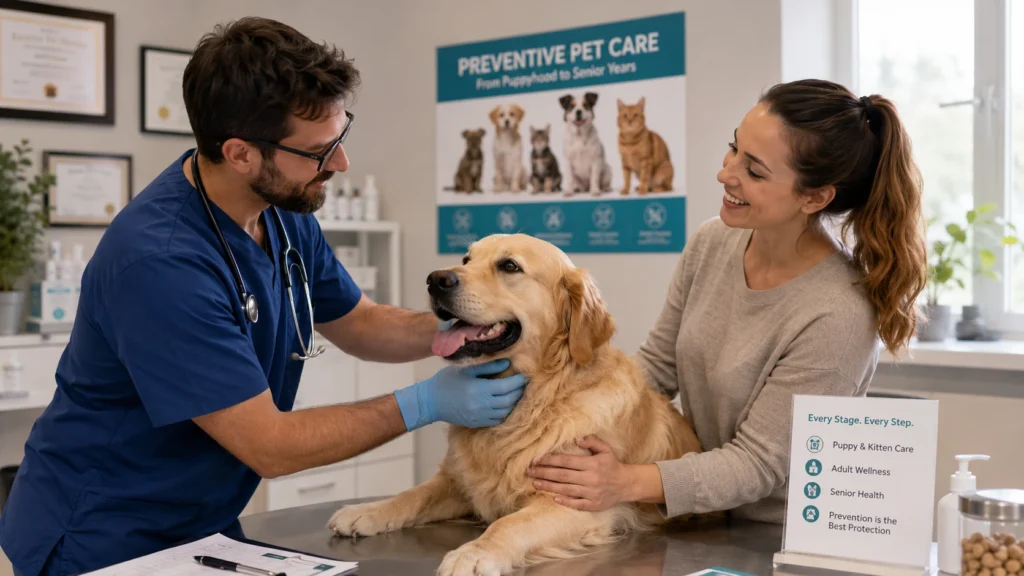
Visits to check on potential health problems and solve them is an obvious step to take in pet ownership, but there are some other aspects of care that require adjustment as well. You would definitely make sure your pet receives proper care if you relocated to a new region or country, wouldn’t you?
Building the foundation: weeks 8 to 16
The first weeks or months of a puppy or kitten are the most medically intensive. Antibodies received from the mother via her milk – passive immunity – are depleted by about 6 to 8 weeks, meaning that the animal is becoming more and more vulnerable, although the immune system itself has not kicked in yet.
That is why it is necessary to introduce the first round of vaccines at this point: maternal antibodies have declined to such extent that they cannot neutralize the vaccine, but the pet has not become exposed to a virus and, therefore, is still unprotected.
Vaccines are given three-to-four weeks apart in order to provide the right timing.
This is a standard protocol: these are the recommended preventive procedures for any pet. In case of dogs, it is the distemper, parvovirus, adenovirus and parainfluenza vaccine (DHPP) combined with rabies vaccines. In case of cats, it is distemper vaccine (FVRCP) and rabies. This is the medical baseline – everything else is additional and optional.
In addition to vaccination, deworming is recommended at this point. Parasites, including roundworms and hookworms, are transmitted from mother to offspring. So puppies and kittens may be born with a considerable worm burden. Therefore, we recommend you to conduct a baseline fecal test by a veterinarian and deworm your pet according to the results.
Socialization is another activity that occurs at this stage, but by socialization we do not only mean familiarizing the pet with other dogs. Socializing with humans is equally important, otherwise the dog may be afraid of the clinic or other dogs if he or she has not been properly socialized with them.
Young adult years: maintaining what you’ve built
From approximately one to six years of age, pets do not need as much medical attention in case they are healthy, but that does not mean our job is done. The priorities have to shift.
Owners may forget about such essential aspects as nutrition and dental care. A spayed kitten eating kitten food does not need any less dental hygiene procedures than a twelve year old cat with poor dental condition. The mix may be different, but the requirements are equal.
Preventing obesity and related complications, like diabetes, by providing the correct ingredients and portion size, recognizing skeletal maturity and switching to the adult food or to energy-appropriate formula with much less carbohydrates and emulsified fats is a bit more complicated task.
Excess calories are the source of several diseases: obesity, joint problems, high blood sugar and liver problems.
It is not just a question of giving a pet fewer calories than it uses in a day. That is how diets are supposed to work on paper, not in a living organism.
Navigating a move to a tropical climate
Preventing health problems associated with such a move should be carefully planned with the help of specific recommendations, which are quite different from those required in cooler areas. If your pets were unneutered in the cooler climate, the difference in day light hours between temperate climate and equator could provoke estrus in females. Also, poisoning is more common among animals in tropics due to insecticidal and acaricidal products used in this area, which are not registered for animals.
International relocation requires a unique set of recommendations, which are sometimes hard to predict and vary between countries. Most of the countries require health certificate executed within 7 to 10 days of the journey, rabies vaccination and microchipping. Some countries – mainly those with low rabies risk – require a Feline/Canine/Ferret rabies antibody titer test, which is used to determine the amount of circulating antibodies. It should be conducted in weeks or months before your trip, since there are established legal intervals within the import process. It is crucial not to miss your travel date.
Upon your arrival, you will have to change your preventive protocols according to the disease threats in this area. Leptospirosis vaccine, which is not a core in temperate countries, becomes necessary in tropical area. Prevention of tick infestation – with suitable topical or oral medication – becomes urgent. Contact a vet clinic Singapore pet owners can visit as soon as possible to arrange an examination and establish the new preventive protocol according to the risks existing in your area.
Remember about your pets’ emotions as well. Major changes in environment: smells, sounds, interaction with different individuals may cause stress and behavioral problems in animals. Separation anxiety is common among animals after relocation, especially if the owner spends more time outside during the day. An enriched environment, a predictable schedule and possibly behavior modification therapy should be included in a care plan, not added later.
The senior threshold: years 7 and beyond
According to AAHA (American Animal Hospital Association), dogs and cats are seniors starting from 7 years old, but large and giant breeds age faster and, therefore, become seniors earlier, close to 5 or 6. However, aging changes more than just the number – it also affects physiology.
Metabolic rate slows. The immune system works less effectively. Organ reserve declines, meaning that kidneys, liver and heart are unable to cope with the stress as well as before. Conditions which were subclinical until then become clinical. Therefore, recommendation regarding examination changes from annual to bi-annual.
Geriatric screening panels, including complete blood count, chemistry panel, urinalysis and thyroid function testing allow us to determine the state of organs before development of symptoms. An elevated kidney value detected on a regular senior exam could be managed with diet and monitoring for years before it causes acute renal failure, becomes more expensive to treat, and leads to a worse outcome.
Early joint support could be helpful before joint problems appear. Osteoarthritis develops in dogs without clear signs for a long period of time before the animal gets lame. Providing joint supplements before this happens allows the cartilage to resist deterioration better. Equally, weight control is needed at this stage, since extra kilogram adds strain to aging joints.
Discuss titer testing with your vet in connection with your senior pet. Instead of annual vaccinations on a certain schedule, titer test allows to determine the level of circulating antibodies and find out whether a booster is needed or not. Senior pets with strong immune systems do not need annual vaccination – and reducing the stimulation of the immune system is reasonable for them.
Home monitoring between appointments
Professional examination can detect abnormalities that owners may miss. Home monitoring allows you to discover those problems that occur in between visits.
Weekly check from nose to tail takes five minutes, and creates that familiarity with your pet’s normal condition which helps to detect abnormality easily. Feel neck and lymph nodes under the jaw of your pet; his gums should be pink and wet (pale and dry indicate anemia or dehydration). Skin turgor test (tenting of skin in shoulders area) gives an idea of your pet’s hydration level. Look at the teeth: check for new tartar formation or redness of the gums. Observe your pet walking when they are not aware that you are watching – early joint problems are evident in the morning, when the animal just got up.
Body weight is the most informative indicator. If your pet lost 5% of body weight over last weeks without changing diet – there must be something going on. Estimate the body condition score of your pet: it is a 1-to-9 system which evaluates fat coverage of the ribs and spine.
Keep a simple record of changes between appointments, including appetite, energy levels, water intake, toilet habits and any new sensitivities. Notes, photographs and short videos can make it easier to explain patterns during a routine visit. This information does not replace professional assessment, but it can help make conversations with the veterinary team focused.
Cost rationale of prevention
Financial benefit from prevention is quite straightforward. Treatment of parvovirus case may cost thousands of dollars and still not save the puppy. A series of vaccines costs much less. Periodontal disease treatment is more expensive than professional teeth cleaning. Diabetic ketoacidosis caused by untreated feline diabetes may require intensive care. Diagnosing the disease after months of high blood glucose can make treatment more difficult.
Preventive care does not prevent all the diseases – some animals become ill anyway. What it does is changing the balance, distributing the cost over many years and providing you with treatment opportunities that may not exist in case of emergency.
The result is a long-lived, comfortable animal which is not spending its valuable life suffering from end-stage diseases or requiring costly treatment. It is not accidental, but reflects the care built into the process.