

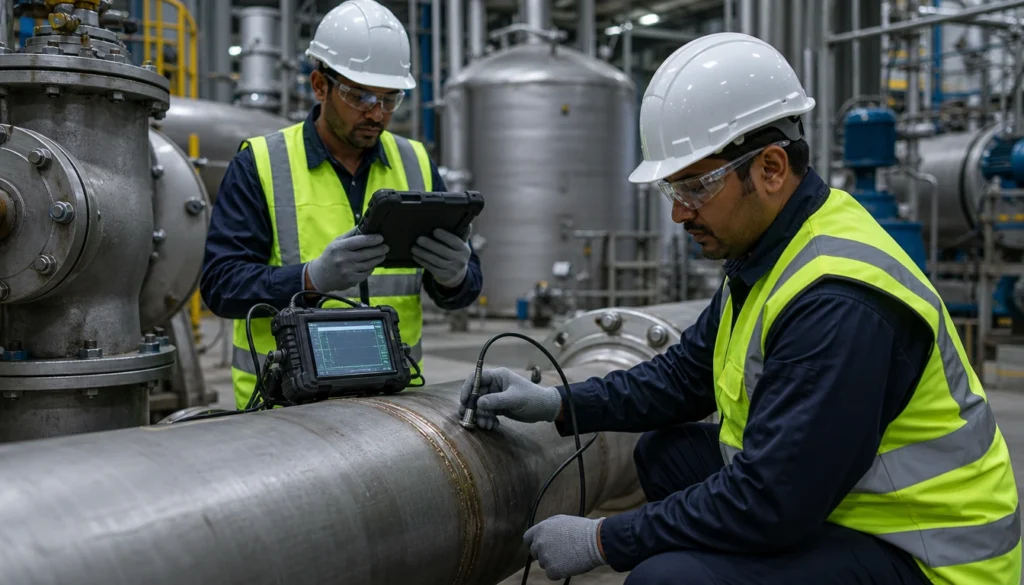
Non-destructive testing (this is commonly referred to as การทดสอบโดยไม่ทำลาย in Thai) reduces downtime by finding cracks, corrosion, wall thinning, weld flaws, and material problems before they force an unplanned shutdown. Instead of waiting for equipment to fail, engineers can inspect critical assets while preserving their structure, then schedule repairs at the right time. For businesses, this means fewer production delays, safer operations, and better control over maintenance spending.
Why Downtime Becomes So Costly
Downtime rarely starts with one dramatic failure. More often, it begins quietly. A pipe wall loses thickness. A weld develops a small surface crack. A pressure vessel carries stress that no one can see from the outside.
By the time the problem becomes obvious, the business may already be facing halted production, urgent repairs, replacement parts, overtime labour, delayed deliveries, and safety concerns. In industries where equipment runs continuously, even a few hours offline can affect revenue and customer confidence.
NDT helps shift the story from emergency response to planned action.
How NDT Finds Problems Before They Grow
The strength of NDT is that it gives engineers a technical view of an asset without cutting, dismantling, or damaging it. Different methods reveal different risks.
- Ultrasonic Testing
Ultrasonic testing uses sound waves to detect internal flaws or measure material thickness. It is especially useful for identifying corrosion loss in pipes, tanks, boilers, and pressure equipment.
- Radiographic Testing
Radiographic testing can reveal hidden weld defects, voids, inclusions, and internal discontinuities. It is often used when weld integrity must be proven with strong visual evidence.
- Magnetic Particle Testing
This technique is used to identify cracks on, or just beneath, the surface of magnetic metals. It is valuable for shafts, welds, lifting equipment, and structural components exposed to repeated stress.
- Penetrant Testing
Penetrant testing highlights fine surface-breaking defects on non-porous materials. It is simple, effective, and useful for components where small cracks could later become serious.
- Phased Array Ultrasonic Testing
Phased array technology provides detailed imaging and accurate flaw sizing. For complex assets, it can support faster decisions and more reliable repair planning.
Turning Inspection Data Into Business Decisions
The real value of NDT is not only in detecting damage. It is helping managers decide what to do next.
A clear inspection report can show whether equipment is fit for continued service, needs monitoring, or should be repaired during the next scheduled shutdown. This allows maintenance teams to group repairs together, order parts in advance, and avoid rushing into expensive emergency work.
For example, a slightly thinned pipe section may not require immediate replacement, but it may need closer monitoring. A crack in a high-stress weld, however, may need prompt repair. NDT helps separate urgent problems from manageable ones.
Why Early Detection Saves More Than Money
Reducing downtime is a business goal, but the benefits go further. Early detection also protects workers, nearby facilities, the environment, and company reputation. When industrial assets are inspected regularly, businesses are less likely to face sudden leaks, ruptures, production accidents, or compliance problems.
It also supports smarter budgeting. Instead of spending heavily after a breakdown, companies can plan maintenance based on evidence.
Keeping Production Moving With Confidence
NDT gives businesses a practical way to protect expensive equipment while keeping operations productive. It helps engineers uncover issues beyond normal visual inspection and convert unseen risks into clear maintenance decisions. For reliable inspection support across methods such as UT, RT, MT, PT, UTM, PMI, eddy current, PAUT, and MFL, contact NDT Thai and keep your facility one step ahead of costly downtime.