
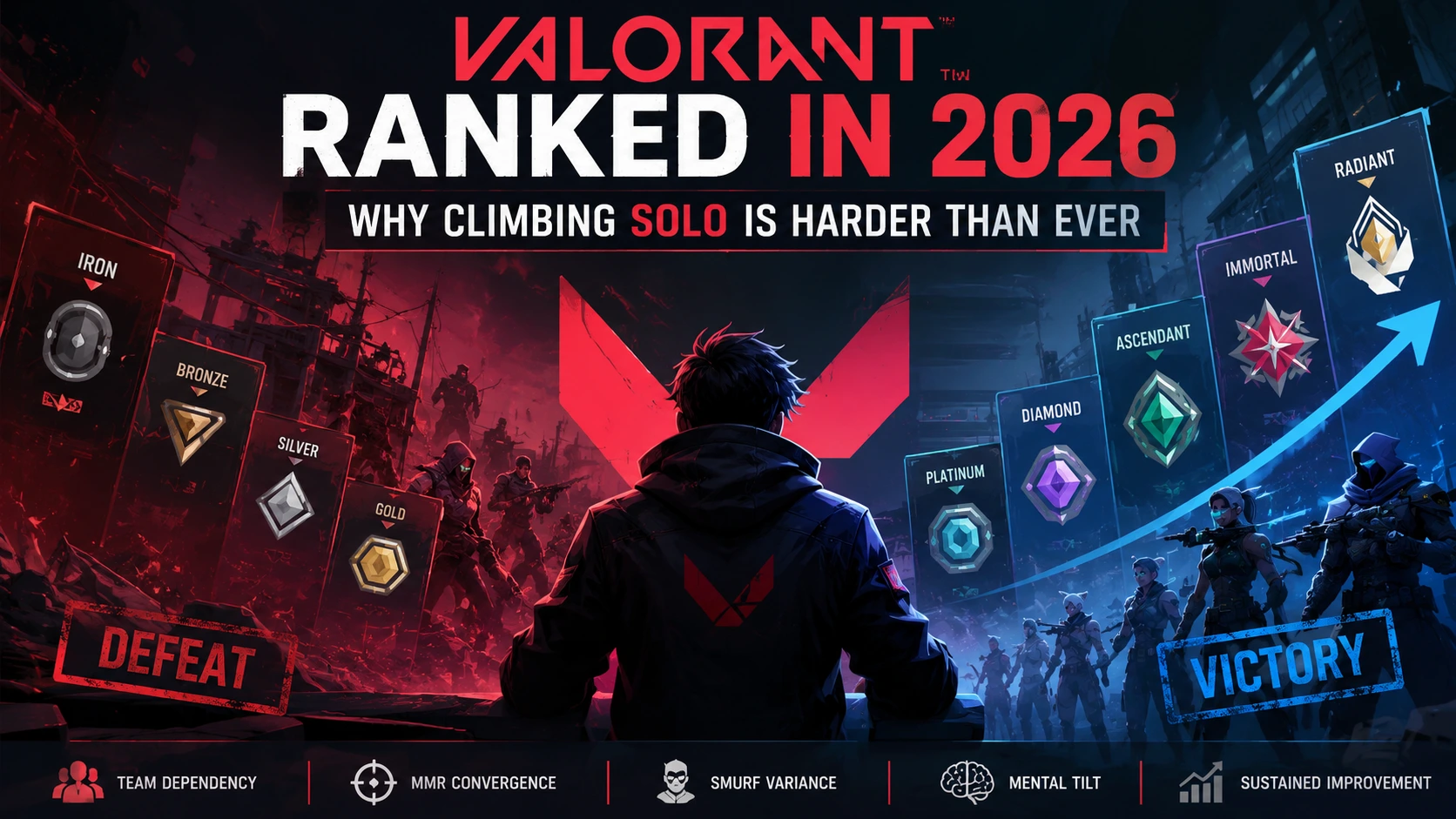
If climbing in Valorant feels harder than it used to, it is not your imagination. Heading through the 2026 season (V26), Riot’s ranked system is smarter, stricter, and more aggressive about pinning you to where it thinks you belong than ever before. For solo-queue players especially, that combination has turned the grind into a genuine wall. This is an analytical look at why solo climbing in Valorant 2026 is so punishing — what the system is actually doing, and what realistically helps.
How the 2026 Ranked System Works
Valorant runs on two numbers. Your visible Rank Rating (RR) is the badge you see; your hidden MMR is Riot’s real estimate of your skill. Four factors set your RR after each game — Win/Loss, Round Differential, a small Performance Bonus, and Convergence — and Convergence is the one that matters most: it constantly pulls your visible rank toward your hidden MMR. If your MMR is above your rank, you gain more and lose less. If it is below, you bleed RR. The whole system is built to drag you to your “true” tier and keep you there.
That design meets a brutally clustered ladder. The distribution below shows where players actually sit.
| Tier | Share of players | Milestone |
| Iron | ~5.9% | The floor |
| Bronze | ~16.8% | Below average |
| Silver | ~22.1% | The lower-middle crowd |
| Gold | ~22.7% | Gold 1 is the statistical dead center |
| Platinum | ~16.1% | Above Plat 3 = top 25% |
| Diamond | ~9.5% | Clearly above average |
| Ascendant | ~5.6% | Ascendant 3 = top 5% |
| Immortal | ~1.3% | Roughly the top 1% |
| Radiant | ~0.03% | Top ~500 per region |
Silver and Gold together hold nearly 45% of the ladder. That is the heart of the problem: most players are fighting through the single most crowded, most sticky stretch of the entire system.
Why Solo Climbing Is Harder Than Ever
Several forces stack on top of each other, and they hit solo players hardest. The table lays them out.
| Force | What it does | Why it punishes solo players |
| Convergence | Pulls rank toward hidden MMR | At your true rank, wins and losses roughly cancel |
| Team dependency | Winning is ~90% of RR | One AFK or troll can sink a game you can’t carry |
| Capped performance bonus | Personal play adjusts RR by only ~±5 | A 30-kill loss still loses RR |
| Smurf variance | Smurfs funnel through low/mid lobbies | Unwinnable games you had no control over |
| MMR confidence | Old accounts are ‘known’ quantities | Harder to move than a fresh alt |
The deepest of these is Convergence. Once the system is confident in your MMR — and on an established account it becomes confident fast — it actively resists letting your rank drift away from it. If you are sitting at your true skill level, you will gain roughly what you lose, game after game, and the ladder feels like a treadmill. Breaking out requires not a good night but sustained, repeated overperformance against players at or above your level, which is exactly the thing that is hardest to manufacture when you are alone with four random teammates. your level, which is exactly the thing that is hardest to manufacture when you are alone with four random teammates.
The Team-Game Trap
Valorant is a 5v5 game where winning is about 90% of your RR, and that math is unforgiving for soloists. You control one fifth of your team’s firepower and none of its coordination. A duo running practiced utility and comms has a structural edge over five strangers typing “sorry” after a lost round. And because the Performance Bonus only swings RR by around ±5, a brilliant individual game inside a loss still costs you points. You can be the best player in the lobby and still go down because the other four did not show up — and the system, correctly, mostly cares whether you won.
The Smurf Paradox
Riot leaned hard into anti-smurf detection for 2026, and it genuinely is more aggressive: drop a 40-bomb in placements and your MMR skyrockets instantly, funneling suspected smurfs up toward Ascendant and Immortal lobbies fast. In theory that protects lower ranks. In practice it creates two problems for honest solo players. First, smurfs still pass through your lobby on their way up, handing you games you were never going to win. Second, if you genuinely have the match of your life, the system can briefly mistake you for a smurf and throw you into a harder lobby next game, where you promptly lose the gains.
There is a deeper irony here. Because the system holds high “confidence” in an established account’s MMR, it is measurably harder to climb on your two-year-old main than on a fresh alt the system knows nothing about. The honest, long-term solo player on their real account is, in a real sense, playing the game on the hardest difficulty.
|
Valorant’s ranked system is ruthlessly logical. It does not care that you had a great game. It cares whether you won — and whether your MMR already decided where you belong. |
What Actually Helps — Within the Rules
Here is the part most guides skip: Riot actively fights crude boosting, so the help that works is not what people imagine. Wide-disparity five-stacks eat steep RR penalties — 25% for most out-of-range groups, climbing to 75% the moment a Radiant joins — and account-boosting via sharing is exactly what the 2026 smurf detection is tuned to catch fast. Naive “get carried to Diamond overnight” schemes are inefficient by design and risk flags.
What does help is the kind of support that works with the system rather than against it. Duo-queuing with a stronger, in-range player adds the coordination and comms that solo queue lacks — the single biggest structural disadvantage soloists face — without tripping disparity penalties. Coaching addresses the only thing that moves a confident MMR long-term: real, repeatable improvement. The most useful Valorant boosting offerings are built around exactly these legitimate forms — in-range duo play and coaching — rather than the account-sharing schemes Riot is designed to punish. Providers such as XBoosty that lead with rules-respecting methods are the ones worth considering, because anything that fights the matchmaker tends to lose.
The takeaway for 2026 is sober but useful. Solo climbing is harder than ever because the system is better than ever at finding your level and holding you there, and because a team game punishes the soloist for things outside their control. You can still climb — but it takes sustained overperformance, the coordination solo queue denies you, and genuine improvement over time. Understanding why the wall exists is the first step to getting over it instead of just grinding into it.
Frequently Asked Questions
Why is it so hard to climb in Valorant solo in 2026?
Because the system’s Convergence mechanic constantly pulls your visible rank toward a hidden MMR it’s increasingly confident about, so at your true rank wins and losses roughly cancel. Add a 5v5 game where winning is ~90% of your RR and you control only one fifth of the team, and solo players face structural headwinds that a coordinated duo doesn’t.
What is MMR convergence in Valorant?
Convergence is the factor that multiplies your RR gains or losses based on how far your hidden MMR has drifted from your visible rank. If your MMR is higher than your rank, you gain more and lose less until they align; if it’s lower, you bleed RR. Once the system is confident in your MMR, it resists letting your rank move away from it.
Does Valorant punish boosting?
Yes. Wide-disparity five-stacks take steep RR penalties (25% for most out-of-range groups, up to 75% if a Radiant joins), and the 2026 anti-smurf detection is tuned to catch account-boosting via sharing quickly. Crude ‘carry me to Diamond’ schemes are inefficient by design, which is why legitimate help focuses on in-range duo play and coaching.
What actually helps you rank up in Valorant?
Working with the system rather than against it: duo-queuing with a stronger in-range player supplies the coordination and comms solo queue lacks, and coaching drives the real, repeatable improvement that’s the only thing that moves a confident MMR long-term. Sustained overperformance against players at or above your level is what convinces the system to move you up.