
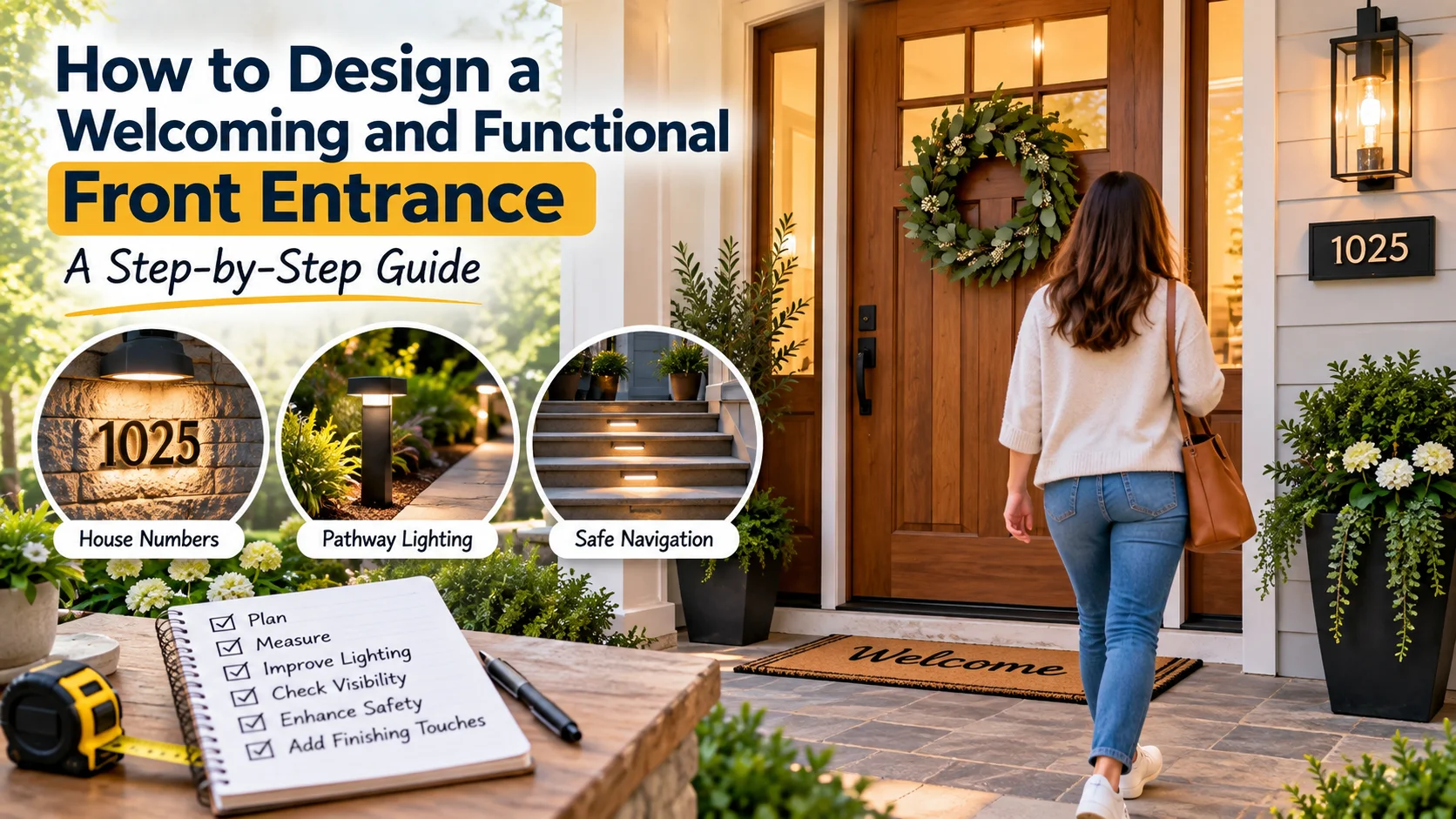
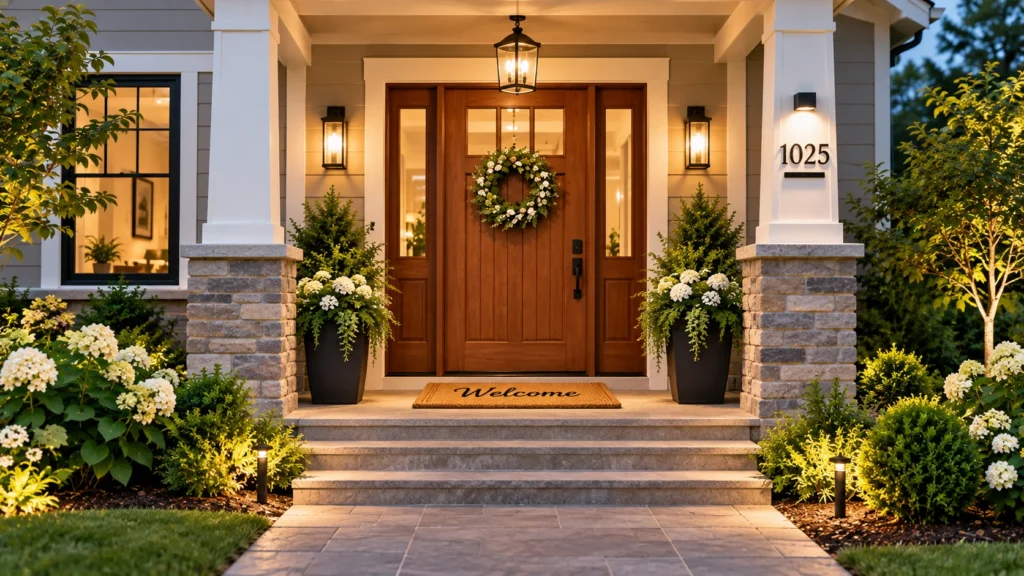
Your Front Entrance Should Do Two Jobs, Which Are Often at Odds
A well-intentioned improvement may make your porch appear more lovely to an approaching visitor, but does it also make the house appear more inviting from the street? Does it guarantee that your house number is still visible after sunset, or that the threshold is easy to see when it starts to rain? Is your porch light really the only choice available for the location where it’s installed
The most lasting improvements will be made by thinking of the front entrance as a process instead of an ornament. Visitors approach, recognize, and find their way to the porch, door, or gate. They may struggle if one part of this pathway is poorly designed, and adding more light elsewhere won’t always solve that problem.
Before installing new light fixtures or repainting front door trim, take a walk around your property at twilight to identify problem areas from the vantage point of an unfamiliar visitor
First Step in Making the Entrance of Your Home Stand Out and Welcome: The View From The Street
You’re several yards away, surveying your frontage, and you’re trying to determine whether your porch lighting makes the house appear desirable and inviting. The question you should be asking is whether it makes the house identifiable.
Look first at the house number. Can a driver see it from the road, or is it tucked out of view next to the threshold or along the side of the house? A house number may appear perfect when perched above the front door, but vehicles, gardens, columns, and other features can block this same number from the street.
Take care that numerals applied to dark bricks remain easily discernable when the day is done, and ensure that the entire number is clearly visible, not just a subset of digits. A common error is to install house numbers where the view is obstructed by seasonal decorations or large objects.
The arrangement of lights on your porch may have more impact than you suspect, too. When you walk this distance as a visitor would, ask yourself if the house looks instantly recognizable, and if there are any visual cues to show the way forward. Can you pick out the front door? Would you hesitate before selecting the second one from the left?
Make Your Home Address Recognizable Even From a Distance
Numbers are small things, sometimes, but they have surprisingly large implications on front entrances. A poorly-chosen number plate, for instance, might not perform well at night or when partially hidden by overgrown shrubs.
First and foremost among number choices is contrast, both in terms of color and brightness. Consider where the number is placed in relation to potential obstacles such as open gates, large shrubs and hedges, parked cars, and holiday decorations. A number that is barely visible at night or obstructed on any other occasion will have to be identified from close quarters on a dark porch.
At the practical level, the porch lights may already be doing their job by making the house visible from the street. They may not reach far enough to illuminate the number, though, or it may hang from ceiling or posts that shield it from view. Most modern homes can be identified with the naked eye from the street, but many require additional lighting to show doorways, numbers, or handles. A solar house number led address sign can provide illuminated identification without relying on the porch light, but it still requires practical placement so that the solar panel receives consistent light and the illumination isn’t wasted on unneeded areas.
A number plate whose color blends into the wall, fence or door may still require illumination to become visible, while one that has been placed to avoid occlusion during the day will do little in poor light. As with any other piece of exterior lighting, consider whether the fixture has been mounted to serve its intended purpose as well as the design needs of the house itself.
After choosing or rotating a house number, test it from several different directions to make sure it’s not visible only when the visitor can already see the threshold. That’s too late in the process to begin identifying your dwelling.
Second Step in Making the Entrance of Your Home Stand Out and Welcome: Lighting the Way to the Threshold
The next element to consider after making the house identifiable is making sure it remains navigable. This is especially important for porches, gates, and doors that aren’t located on a straight path from the street.
While touring this location in darkness, take careful note of any uneven surfaces that could cause tripping, places where illumination is blocked by landscape or structures, and the general layout of the ground. Once again, you’re looking for potential confusion at short range on the approach to the threshold. Avoid overlighting this zone, but provide enough so that visitors can see any steps, edges or other hazards.
Lights along this pathway act as navigational aids, but they should complement rather than overwhelm the surroundings. This consideration becomes more important as the route becomes more complicated. A straight path requires less help than one that turns, and wider paths may be lit more intensely than narrower ones. Steps must be considered carefully, since an overhung porch will cast shadows over the nearest step regardless of their location.
Illuminated wayfinding signs aren’t restricted to public places – they’re appropriate anywhere a visitor must find their way to an entry point. That includes private residences, with special attention paid to secondary entrances that require additional lighting for safety or security. Don’t forget that these elements are judged from street level, though, so look over potential fixtures for glare, shadows, and hazards. A visitor arriving on a porch might expect lighting that feels closer to interior lighting, but that effect is lost if the brightness has been turned up to maximum.
Lights throughout this region serve specific functions, from indicating turns to avoiding obstacles and illuminating thresholds. That doesn’t leave much room for decorative elements, but practical additions can be combined with existing structures. Install these items in logical places relative to the overall layout, and be sure that the brightness serves the purpose rather than shining light on nearby structures and plants.
Third Step in Creating an Entrance to Home that Makes People Feel Welcome: Use the Porch Light to Complete the Journey
The Porch light’s job is only to complete the journey. That isn’t an invitation to ignore obstacles or hazards on the approach, but it does mean that your lighting plan must provide enough illumination for the visitor to observe their surroundings.
Stand at the doorway and make a mental note of each element that requires examination: the threshold, door handle, bell, number plate (if installed) and any step leading to the porch itself. These items become more important as the journey continues, and an unthinking placement of a light source can cause glare or shadows that obscure them. A porch light that shines up and across walls or ceilings may create interesting effects, but these effects conceal objects that a visitor must see.
More light is generally good, but an excessively bright porch light combined with very dark ground cover produces an undesirable effect. A visitor is apt to look up and away from the ground to find source of illumination, which can be even more challenging if there are fixtures further along the path that appear equally as bright. A combination of lower-level fixtures and careful aiming can produce better results by breaking up the distance and filling in zones that are unlit by larger items.
Shadows play the same trick, with the potential to hide useful information like the threshold leading into a porch. Examine these effects closely to ensure they don’t conceal objects without reason, and consider relocating an object or a light source. Fixtures attached to surfaces may cast shadows over valuable information like house numbers, and overhanging structures reduce visibility even further.
Use Motion Lighting to Good Effect by Locating it Where It Does the Most Good
Lights that turn on at the approach are helpful only if they illuminate something useful. Motion sensors on fixtures that use them should be configured to avoid false positives like pets and weather effects, turning on only when a person enters the zone of influence.
Lights that aren’t used regularly should have motion sensing capabilities to reduce wastage, and those that turn on briefly when triggered can be combined to advantage. Side gates, secondary entrances, garages, and bins are good candidates because illumination is needed only when a person is present to receive or examine these items. Fixtures that turn on automatically as a person passes are good candidates for similar considerations. Place these items where they can provide illumination without interfering with the approach to the porch.
As always, ensure these features can be seen from the intended vantage point before making adjustments. If a visitor isn’t able to see a gate, for example, a motion-controlled lamp will turn on when they should be paying attention. A sudden flare of light on an unfamiliar porch could blind a visitor, and the effect is just as disorienting on the return trip.
There’s nothing wrong with motion-sensing lamps, but the best use of these devices is to accomplish one very particular task each time. Motion sensors might be turned off or reduced in sensitivity so that lights aren’t triggered unnecessarily.
Consider the intended task for each motion-controlled light, and test its effectiveness. If it has an unusual or undesired effect, locate it elsewhere or configure it to accomplish a known task. A motion-activated light might reveal a step, for example, or illuminate a side gate before the visitor passes through it.
Fourth Step in Creating an Entrance to Home that Makes People Feel Welcome: Keep Everything Within Reach and Maintain It
A newly-installed set of lights may provide excellent illumination for weeks or even months, but changing conditions reduce the value of that illumination with time. Shrubs and hedges grow large enough that letters on the house number are no longer visible, and the front door is harder to determine at night.
Make certain that all house numbers can be seen from a distance by ensuring that they are unobstructed by growth or decorations. Trim hedges and shrubs to maintain this visibility, and wipe down exterior fixtures as needed to keep them clean when the accumulation of dirt affects illumination. Solar elements should be kept free of obstruction to allow optimum power collection, and rearranged if this isn’t possible. New locations may be necessary to collect enough light during the winter months, when the sun reaches its lowest position in the sky.
Test these lights at night a few times each year to find and correct these issues, particularly before the beginning of a new season. Changes in the angle of the sun can be more dramatic in some areas than others, and holiday decorations or vehicle placement changes may also affect the visibility of your porch fixtures.
Walk the front entrance as described, keeping an eye out for changes in the environment
Test the View From The Street to Identify Problems That Require Repair or Adjustment
A visitor will begin their journey from the street to determine whether your front porch is inviting and well-lit. To find out how this might appear to them, begin at the roadside and follow the same procedure used for locating the view from your own porch.
Walk past your residence and look for clues that the house could be identified from this direction, then return to see how these choices perform. Examine the threshold and door as a visitor would, and turn back to make sure the departure is no less accessible than the arrival. If a task proves more challenging from this vantage point, make adjustments in the same fashion as previously described. This may seem like a lot of effort for the sake of lighting on an unneeded part of your property. A house number or threshold that isn’t in view still provides vital information to a visitor, and a few strategic changes can completely change an entrance.