
For supply chain executives and plant operations directors, navigating the transition to sustainable packaging is a complex operational challenge. Global mandates are forcing a rapid shift away from single-use plastics, placing immense pressure on packaging facilities to scale alternative solutions.
While the demand for sustainable options is clear, executing this transition at a high volume without destroying profit margins requires rigorous engineering. Facility managers must balance aggressive sustainability targets with strict capital expenditure (CAPEX) controls.
This technical guide explores the engineering tolerances, automation systems, and integration strategies required to scale high-volume paper bag manufacturing profitably.
The Shift Toward Circular Packaging Economies
The global supply chain is currently undergoing a massive restructuring driven by widespread plastic bans and aggressive corporate ESG (Environmental, Social, and Governance) targets. To remain compliant, multinational brands are rapidly transitioning to paper-based flexible packaging.
However, for manufacturing facilities, this transition introduces a critical operational bottleneck. Legacy plastic extrusion and converting lines cannot be seamlessly retrofitted to handle paper substrates. Paper lacks the elasticity of polymer films, making it highly susceptible to tearing under high-speed mechanical stress.
The core pain point for plant directors is clear: how to upgrade infrastructure to meet the surging demand for paper packaging while strictly controlling the capital expenditure required for new, specialized converting machinery.
Key Engineering Tolerances for High-Volume Production
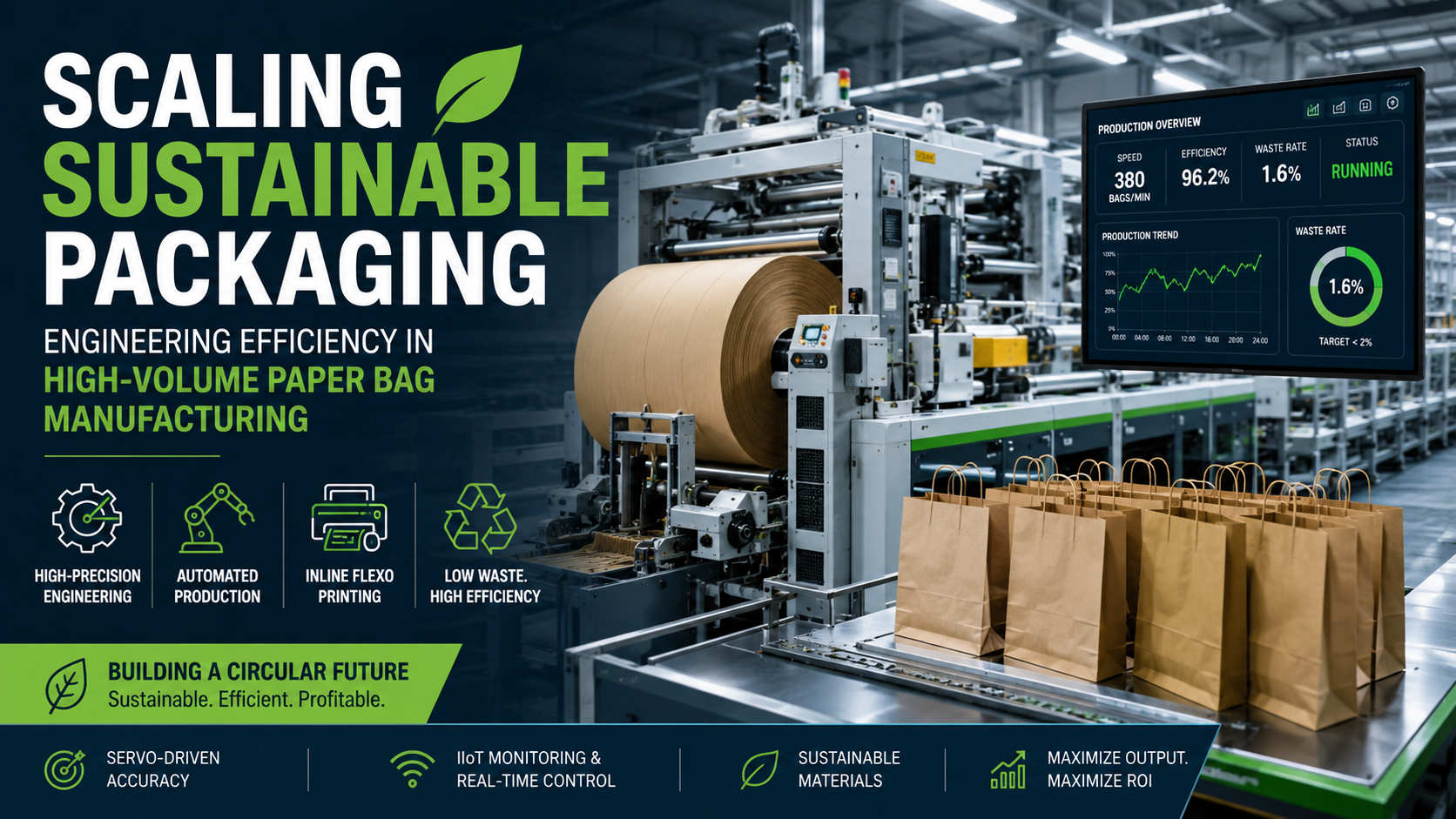
When upgrading a production facility to handle sustainable materials, mechanical precision is the primary factor dictating long-term profitability. High-volume environments require automated systems that maintain strict web tension control and minimal servo-driven accuracy deviation to prevent catastrophic web breaks.
For reference, leading fabricante de maquinaria de embalaje (packaging machinery manufacturers) such as KETE Group engineer their paper bag making systems to maintain extreme precision at output rates exceeding hundreds of units per minute. Establishing these mechanical baselines ensures that plant managers can scale output sustainably without increasing material waste.
To guarantee continuous operation and a low downtime rate, facility managers must evaluate machinery based on the following engineering tolerances:
- Dynamic Web Guiding: Systems must feature ultrasonic or optical edge sensors to continuously correct lateral paper drift within millimeters.
- Servo-Driven Draw Rolls: Independent servo motors are required to maintain perfect synchronization between the unwinding, gluing, and cutting stations.
- Thermal Adhesive Consistency: Glue application systems must feature precise temperature regulation to prevent adhesive degradation or weak structural seams.
Minimizing Material Waste Through Automated Calibration
In high-volume paper packaging manufacturing, material costs constitute the vast majority of operational expenditure. Even a marginal increase in the scrap rate can devastate a facility’s unit economics.
Modern packaging lines combat this by relying heavily on the Industrial Internet of Things (IIoT). Networked sensors continuously monitor the physical properties of the paper roll, instantly detecting microscopic variations in caliper (thickness) or moisture content.
By utilizing automated calibration technology, these smart machines adjust roller pressure and blade timing in milliseconds. This closed-loop feedback system effectively reduces raw material waste—including both kraft paper and industrial adhesives—to below 2%, drastically improving the profit margin per unit.
Integrating Flexographic Printing into the Production Line
Historically, high-volume packaging manufacturing required a decoupled process: paper rolls were printed in a specialized facility, transported, and then fed into a separate bag-making machine. This disjointed workflow inflated lead times and multiplied labor costs.
To achieve true operational efficiency, modern facilities are deploying Inline Flexo Printing technology. By synchronizing high-speed flexographic print decks directly onto the bag-making assembly line, manufacturers consolidate two highly complex processes into a single continuous run.
This integration eliminates intermediate warehousing, drastically reduces manual roll handling, and cuts overall production lead times. Furthermore, modern inline systems utilize fast-drying, water-based inks that align perfectly with sustainable manufacturing protocols.
Regulatory Compliance and the Future of Packaging
Investing in high-precision, low-waste manufacturing infrastructure is no longer merely a strategy for improving unit economics; it is a prerequisite for participating in the modern global supply chain.
The push for advanced manufacturing infrastructure is closely tied to evolving global legislation. According to insights from the World Economic Forum, the collective global effort to transition to a circular packaging economy could drastically reduce plastic leakage into natural environments while creating billions in economic value.
For manufacturing stakeholders, aligning production capabilities with these systemic changes is no longer optional. Investing in compliant, high-efficiency equipment is a baseline requirement for securing future market share and avoiding incoming carbon taxes and plastic penalties.
Conclusion: Conducting a Machinery ROI Audit
Scaling sustainable packaging production requires a fundamentally data-driven approach to mechanical engineering. By prioritizing servo-driven accuracy, inline printing integration, and automated waste reduction, packaging plants can successfully navigate the shift away from plastics.
Before committing to massive capital expenditures, plant operations directors should initiate a comprehensive Machinery ROI Audit. By accurately mapping the downtime rates, material waste percentages, and energy consumption of their existing legacy equipment, managers can build a mathematically sound business case for modernization.