
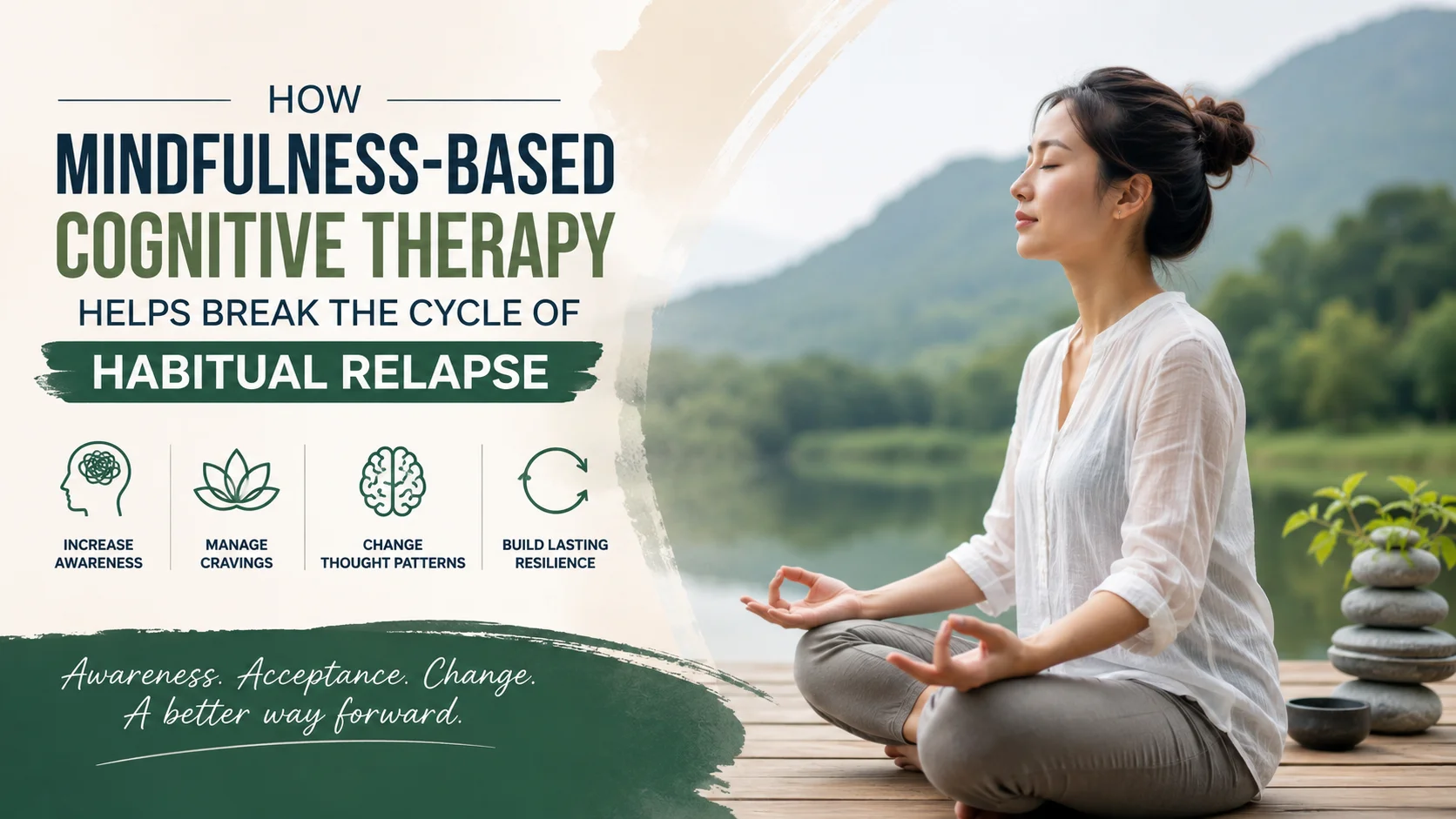

Returning to an addictive or maladaptive behavior after taking a break from it can make someone feel like they’ve failed themselves or disappointed their loved ones. And when someone else relapses, we often think, in that judgmental way humans have of each other, that the person obviously wasn’t ready to change or didn’t have the discipline to do so. From the outside, relapse looks like weakness or a lack of seriousness.
Relapse is a Habit, Not a Character Flaw
One number that is not mentioned in most discussions about addiction and mental illness is that between 40-60 percent of people treated for substance use disorders will relapse at some point. This is the same relapse rate as for other chronic conditions, hypertension relapses in 30-50 percent of patients, asthma in 50-70 percent (NIDA). Nobody tells a person with asthma that their flare-up was a moral failure. Yet relapse in addiction or depression still gets treated like proof of weak character.
The analogy is appropriate because the same thing is happening in the brain. Repeated substance use or repeated depressive episodes wire a stress response, a set of triggers, and a familiar coping behavior into a tight neural circuit. Over time, that circuit fires faster than conscious thought. A stressful email, a certain street corner, a specific mood, any of these can trigger the old routine before a person has had a chance to decide anything. This is why willpower alone so often fails. Willpower assumes the problem lives in conscious choice. But the habit loop, cue, routine, reward, operates mostly outside of it.
Where MBCT Came From
Mindfulness-Based Cognitive Therapy (MBCT) was actually devised by academic researchers Zindel Segal, Mark Williams, and John Teasdale, who first wrote about it in 2002. They didn’t have addiction in mind, though. They were targeting depressive relapse, especially in individuals with one or more prior episodes who are at particularly high risk of experiencing another.
MBCT fits into a broader family of approaches often categorized as third-wave cognitive behavioral therapy. Classic CBT, the kind that’s been around for dozens of years, generally tries to shift the content of a thought, by disputing it, testing the evidence, substituting a more accurate thought in its place. Third-wave approaches, including MBCT, operate on a different principle. Rather than getting into a fight with the thought, they instead seek to change the person’s relationship to it. The thought “I’m going to fail again” doesn’t need to be proven untrue. It just needs to be recognized for what it is: a mental event passing through, not an order-giving reality.
That conceptual pivot is accomplished by way of what’s become a relatively standardized vehicle for these publicly funded interventions: an eight-week, group-based course that mixes CBT-style psychoeducation and discussion with basic, daily mindfulness meditation practice. The format isn’t incidental. It’s how you make an intervention that’s conducive to running in a real-world healthcare context. And that’s part of why it’s become increasingly reimbursed by insurers and offered within the context of outpatient, intensive outpatient, and partial-hospitalization programs, rather than existing only in the alpine reaches of specialty wellness retreats.
Why This Belongs Inside a Full Treatment Plan, Not as a Solo Technique
MBCT works best when incorporated into a treatment plan, rather than added haphazardly to a life that’s otherwise unchanged. An eight-week group skill isn’t a DIY substitute for medical monitoring where necessary, or being in a safe, drug-free space in early recovery, or for proper ongoing treatment that includes looking at how mood disorders, cravings, and mindfulness practice may interact over time.
That’s also part of why many effective programs are simply taking mindfulness-based work and other evidence-backed approaches and including them in the overall treatment model, rather than viewing them as standalone options to be used at the client’s discretion. Programs like Legacy Healing Los Angeles build these techniques into a broader continuum of care, which is the setting where the research on MBCT and MBRP really shines, as part of a broader treatment plan implemented by medical and therapeutic staff and reinforced by aftercare. It’s not a wellness trend in the lives of well people. It’s an adjunct therapy in a clinical setting.
The Mechanism: Metacognitive Awareness
The skill of metacognitive awareness at the core of MBCT is also referred to as decentering. While these terms may sound abstract, they are easier to understand when put into practice. For example, a person recovering from addiction becomes aware of the thought “I need a drink” as it arises. Instead of immediately acting on it or trying to block it out, they simply observe the thought. They notice that a craving has manifested, that it’s a strong one, and that it will transform and fade over the next few minutes whether or not they satisfy it.
This may seem insignificant, but the effects of careful observation become clear when the opposite occurs. Trying to suppress an uncomfortable thought, a craving, or a strong emotion rarely works. The more effort that goes into fighting against these thoughts and feelings, the more exhausting and intense they become. This type of process is usually familiar to anyone who has ever had to “try not to think about something.” MBCT invites individuals to stop fighting their thoughts and instead to carefully observe them. Somehow, the urge seems to lose its power when it is no longer resisted.
Depressed individuals are often caught in an intense state of rumination, an overwhelming loop of self-criticism and negative evaluation such as “I shouldn’t have done that,” “what is wrong with me?” and “this always happens.” Those struggling with addiction experience a similar loop focused on craving and shame. The longer they ruminate, the worse they often feel, and the more enticing return to the old habit appears to be as a way to escape the pain. Research into brain function on depression and addiction has revealed that these loops engage the default mode network, the brain’s resting centre for self-directed thought. Mindfulness appears to reduce the activity in this network, another reason the craving loop may loosen its grip following repeated practice.
Tools That Interrupt the Chain Before the Choice Point
MBCT isn’t abstract philosophy delivered in a group room. It comes with specific, repeatable techniques designed to interrupt the cue-to-relapse chain before a person reaches the moment of choice.
The three-minute breathing space is probably the most-used tool outside of the session. It’s a short, structured check-in: noticing what’s present (thoughts, feelings, body sensations), narrowing attention to the breath, then widening awareness back out to the body as a whole. People use it in the exact moments that used to trigger automatic reactions, sitting in a car outside a bar, right after a stressful phone call, lying awake at 2 a.m.
The body scan trains attention more broadly, building the underlying skill of noticing internal states without immediately reacting to them. And urge surfing, borrowed directly into the addiction-specific adaptation of this model, teaches people to treat a craving like a wave: it rises, peaks, and falls on its own, usually within 15 to 20 minutes, whether or not anyone acts on it. Riding out the wave instead of either suppressing it or giving in to it is a skill that gets sharper with practice, not something people either have or don’t.
What the Evidence Actually Shows
The credibility of MBCT doesn’t rest on testimonials. Teasdale and colleagues’ landmark 2000 trial found that among people with three or more prior depressive episodes, MBCT cut relapse rates from 66% down to 37% compared to standard care. That’s not a marginal effect. Later meta-analyses, including work published by Kuyken and colleagues in 2016, confirmed the effect held up across multiple studies and settings, particularly for people with a history of recurrent depression.
The addiction-specific version Mindfulness-Based Relapse Prevention was developed by Sarah Bowen and colleagues by adapting the structure of MBCT to substance use disorders and pairing it with Alan Marlatt’s earlier relapse prevention model, which focused on identifying high-risk situations and building coping responses before a lapse turns into a full relapse. Randomized trials on MBRP found lower relapse rates among participants compared to standard aftercare groups, with some of the strongest effects showing up over longer follow-up periods, suggesting the skills keep compounding well after the eight-week program ends.
None of this is presented as a replacement for medical treatment. Mindfulness-based approaches are built to strengthen medication-assisted treatment and other evidence-based interventions, not substitute for them. That distinction matters especially for people managing dual diagnosis, where an untreated depressive or anxiety disorder sitting underneath a substance use disorder substantially raises the odds of relapse. Treating one without the other tends not to hold.
Reframing the Slip
One of the most helpful things MBCT is set up to do is take the moral weight right out of a slip. In most recovery stories, a lapse is treated as the occasion when you prove that you are a bad person, the shame spiral that ensures that the relapse will be total. MBCT does it differently: you treat the lapse as information. It is early warning feedback that this trigger, or this mood, or this situation needs a bit more of your careful attention in your practice, but it is not evidence that the whole thing is a waste of time.
Built right into that reframe is self-compassion, as a clinical tool. Meantime, shame is one of the most effective triggers for relapse known to man, the ‘I already blew it so why bother’ logic that turns one slip into a month-long bender. A kind, un-shaming attitude to your own struggles is not an optional form of self-indulgence. It is a necessary clinical intervention to stop a lapse morphing into something bigger.
And the thing about staying well is not that you need to grit your teeth white-knuckled through the tough moments until eventually you are so worn down you hardly care anymore but day-to-day practice that makes the new response at least as automatic as the old one. More automatic if possible, more desirable in the sense of being kinder both to yourself and to those around you because the one thing about being an addict is that you cannot confine the harm to yourself. This is not a metaphor. This is because of how the brain really works, and it is the reason that this one works not just on paper but in the clinic.