
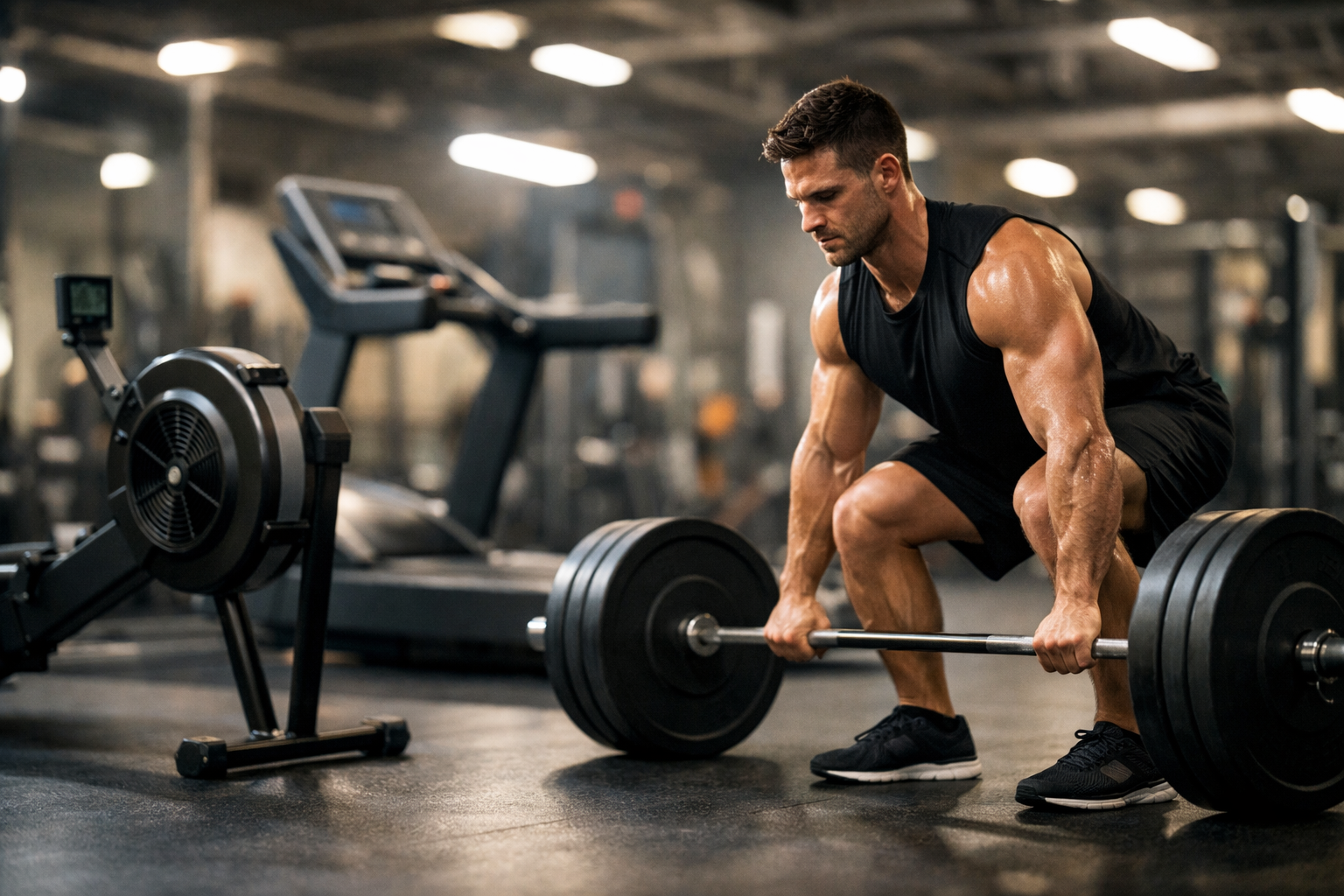
If all you know is the rower, it’s time to cheat on it. “A diverse training stimulus is what most people need to get stronger, fitter, and build more robust athletic capacities,” says Trevor Thieme, C.S.C.S., Openfit’s senior fitness and nutrition content manager.
Maybe your form when doing a thruster is a nightmare. Or the first time you try a Farmer’s walk, your forearms are ruined for days. That’s good! It means your body is doing something novel, and that’s an important part of how adaptation works.
What the Rower Can’t Give You
The rower doesn’t move your body in space. It’s pretty much the same as lifting a weight up and down, just for a much longer time and distance.
What needs to be understood is that most sports and real-world activities require lateral motion and rotation. Twisting and reaching for a tennis ball. Bending and lifting a case of bottled water. Extending and powering a golf swing.
Most injuries in life come from overreaching in an uncoordinated position. The sudden twist, the lunging catch, the hipping out of a tackle. Rowing is all forward and back in a very controlled position which isn’t dynamic at all.
Why Mixing Styles Stops the Plateau
Training adaptation occurs when your body’s faced with something it hasn’t figured out yet. Keep doing the same 30 minutes on the rower each day, and in a few weeks, your CNS has slapped the “that’s normal” sticker on it. Your heart rate at the same pace drops. Your caloric burn lowers. The body is an efficient machine, it will take the path of least resistance every time.
The compound movements plus varied cardio constantly present new problems to the nervous system. A heavy deadlift followed immediately by a 30-second sprint is not a problem your body has a clean answer to. It’s got to recruit, recover, and recruit again across different energy systems. That’s where progress is made.
This approach actually has a name in programming circles: density training. The method is simple, push a compound lift at a challenging weight, move straight into a cardio burst, then rest. Rinse for 4 to 6 rounds. You can create a complete workout in less than 45 minutes that trains your strength, aerobic, and anaerobic capacity all at once.
Choosing the Right Tool for the Session
Not every session needs to be a hybrid. Some days call for sustained aerobic work to build your VO2 max base. Others call for heavy compound work with minimal cardio. The useful skill is knowing which to reach for and why.
If your goal on a given day is metabolic conditioning, high caloric burn, EPOC, and speed, the format matters more than the equipment. A HIIT treadmill workout vs functional training comparison breaks down how the two formats differ in output and what each one is actually training, which helps you make that call based on your specific target for the day rather than habit or convenience.
Building Strength that Protects You
People throw the term “usable strength” around a lot, but we mean it in a very real way. Usable strength is the kind that transfers outside the gym. It’s the kind that lets you carry, brace, stabilize, and recover under load. Machine-based cardio exclusively can actually work against this by creating muscle imbalances: strong in the prime movers the machine uses, weak in the stabilizers it ignores.
Proprioception, the body’s ability to track its own position in space, improves through varied, unstable movement. Heavy compound lifts, especially unilateral ones, build this in ways seated or fixed-path machines don’t. Over time, better proprioception means fewer ankle rolls, fewer lower back strains, and better coordination under fatigue.
Train for a Body that Works
It’s not only about improving your cardiovascular fitness. It’s not only about getting stronger. The ultimate goal is to have a body that can handle a challenging 5k run and still be able to help a friend move heavy furniture, without causing you pain for the rest of the week. This kind of body is developed by combining different cardio exercises with compound movements, rather than just sticking to one type of exercise and crossing your fingers. If you enjoy using the rower, that’s great, continue to use it but remember to include other exercises as well.