
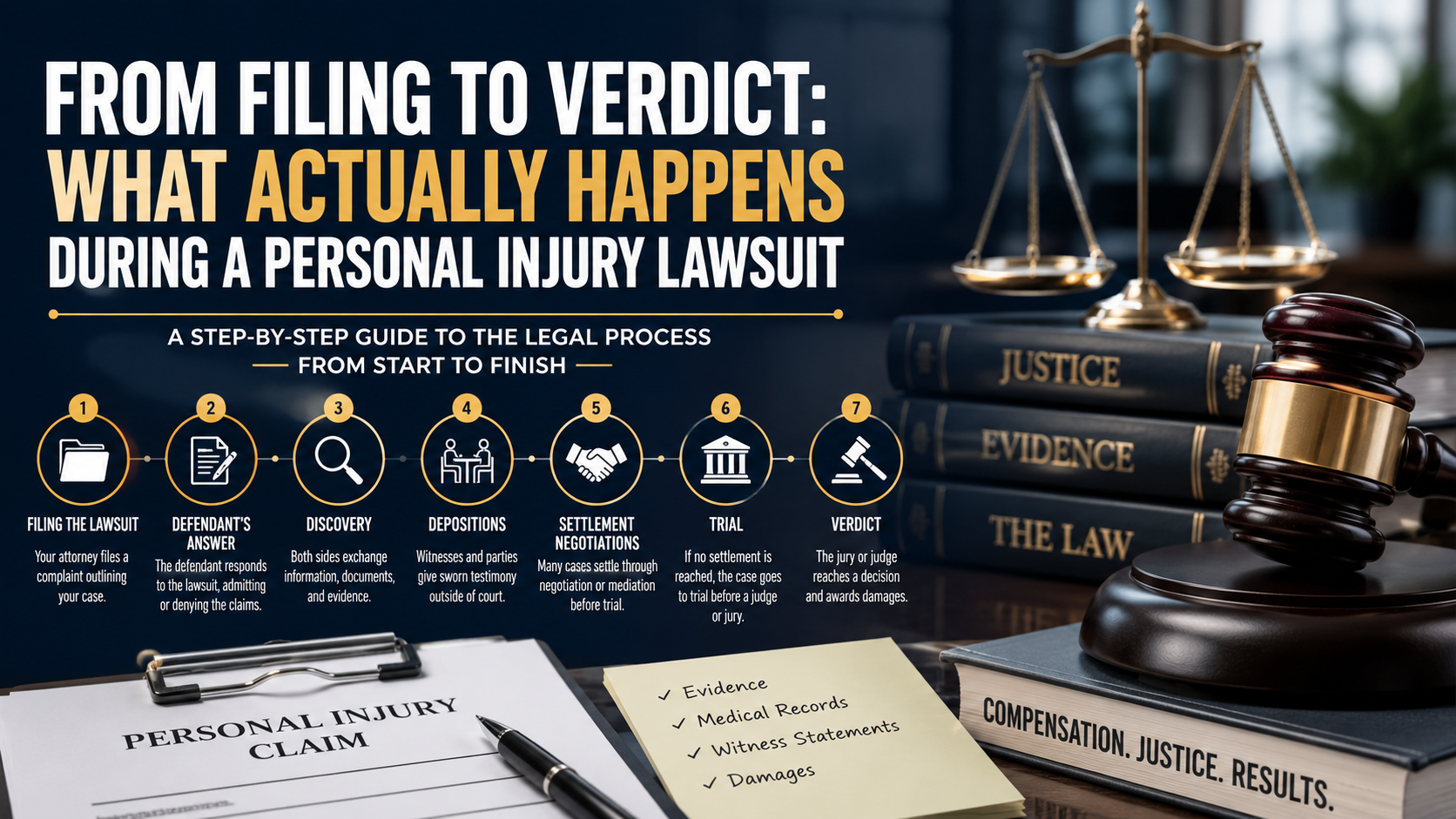
Many individuals that have sustained injuries due to the negligence of another do not have a complete understanding of the commitment and time it takes to go through with a personal injury lawsuit. The steps do not mirror any type of courtroom drama that you may have watched, and the process is not a quick one.
It can be broken down to specific steps that form the foundation of your case and can ultimately lead to your success or failure.
When A Lawsuit Actually Begins
The first choice is never filing suit. Ideally, liability, damage, and insurance issues resolve themselves out of court, giving you a fair offer quickly after the accident. That doesn’t always happen, though. An experienced car accident attorney can advise you on when to take a good offer and when to keep pushing. Tips and opinions vary, but most attorneys will tell you that it’s not a great idea to dig in your heels over a few hundred dollars if the settlement checks every box.
Deciding when you’re cutting yourself short, though, is what you’re paying your lawyer for. If you keep negotiating over truly needed expenses and they call your bluff, or drag it out long enough past the filing deadline, you’re stuck with the offer on the table, like it or not.
That deadline matters more than most people realize. Every jurisdiction enforces a statute of limitations – a hard cutoff by which your lawsuit must be filed or you permanently lose the right to sue. Miss it by a day and the case is gone, regardless of how strong the facts are. Because of deadlines like this, partnering early with a beaumont car accident attorney ensures that critical evidence gets preserved and filing requirements don’t catch you off guard.
Drafting And Filing The Original Petition
The lawsuit gives the defendant (and their insurer) specifics they can use to evaluate the case against them, and to decide whether to contest the lawsuit or try to negotiate a settlement. It also lets their insurance carrier know the size and scope of their potential liability, so the adjuster can begin analyzing the damages portion of the claim.
If the lawsuit goes to trial, the most plaintiff-friendly lawyers will file motions and raise objections before and during the trial, trying to get the judge to exclude evidence, limit testimony, or declare mistrials. That’s another reason you should choose your attorney carefully – and promptly – to represent you in your personal injury case.
The Defendant’s Answer
Upon being served, the defendant, or more accurately their insurance company’s defense attorney, officially responds. This is not a document you’re going to want to pour over for any real information. At least 90% of a standard defense answer is perfunctory blanket denials and boilerplate affirmative defenses.
The single most common affirmative defense in auto accident litigation is comparative negligence – the plaintiff’s own contributory role in the accident. Under comparative negligence rules, if a jury thinks you were 20% at fault, your recovery is reduced by 20%. Defense attorneys broadcast this in their opening answer as a matter of reflex, whether the facts of the accident support it or not, as it gives them a negotiating point to work with throughout the litigation.
The Written Discovery Phase
The real work starts with discovery, and it takes more time than your client may think. This phase may last three, six, or even more months, depending on the case’s complexity.
Both sides send each other formal written requests. Interrogatories are written questions requiring written answers given under oath. Requests for production are demands to turn over documents. This can include medical and repair bills, employment records to prove lost income, and any other documents related to the lawsuit. Requests for admissions ask the opposing party to admit or deny certain statements of fact; if the other party admits the fact, you no longer have to prove it at trial.
In car accidents, discovery goes beyond paperwork. Many late-model vehicles have event data recorders – black box data similar to that on airplanes. This recorded information can be overwritten if not preserved quickly. Cell phone records can also be requested and used to show texting or calling at the time of a crash. Many businesses also have surveillance cameras that may capture a collision. The sooner an attorney can secure this evidence, the better.
Depositions: What To Expect
A deposition is your sworn testimony given outside of court and recorded by a court reporter. Normally, the defense attorney questions you for a few hours, while your attorney is present the entire time.
The defense isn’t just looking to gather information in a deposition; they are sizing you up. How clearly do you remember the details of what happened? Are your answers today similar to what you’ve said in the past? How well do you handle stress? Defense lawyers are deciding if you would make a credible, appealing plaintiff in front of a jury. If you come across as confused, contradictory, or combative, it changes their picture of what the case is worth, because making settlements or persuading juries with weak plaintiffs is more difficult.
Your attorney will coach you on this. Typically, that involves sticking to answering only what you were asked, requesting clarification if you’re unsure about a question, and using concrete explanations to describe your injuries and how they affect your life. A well-coached deposition doesn’t just build your case, it underlines your upper hand.
The Role Of Expert Witnesses
In the vast majority of car accident cases that are even close to trial, the answer is yes. Most likely, multiple experts. These are outside professionals with specialized knowledge brought in to weigh in on specific questions that judges or jurors wouldn’t know enough to evaluate on their own.
On the liability side, that could mean an accident reconstructionist who uses evidence from the scene, data from the vehicles, and basic principles of physics and engineering to build a virtual model of the crash. That model shows exactly what happened, how fast everyone was going, what the driver and passengers in the cars could and couldn’t have seen.
When the defense is arguing that our client is actually to blame, or that they should only share part of the fault, the accident reconstructionist’s testimony will expose those arguments as irresponsible distortions of the truth. Victim-blamers hate accident reconstructionists.
Mediation: The Most Likely Resolution Point
In most jurisdictions, a case must be mediated before going to trial. Mediation is a formal negotiation in which a neutral third party (the mediator) structures a dialogue between the opposing sides.
Typically, the process begins with a joint meeting where each side has a chance to make a short presentation. After the joint session, the mediator separates the parties into different rooms and meets with each side privately. The parties then often go back and forth with the mediator playing devil’s advocate, pointing out weaknesses in each side’s case. The goal is to reach a settlement at mediation, but that isn’t always possible. If the case doesn’t settle, we’ll be in a better position to go to trial.
Very few cases go to trial. 97% settle (according to the U.S. Bureau of Justice Statistics). Of that 97%, most settle during or after mediation. So, the mediation is likely the high point in time at which a personal injury lawsuit is resolved. If the parties reach a deal, the case is over. The client gets paid and the lawyer gets paid. The months of discovery and expert work weren’t wasted, however. That preparation is what brought the insurance company to the table with enough money to make the case real.
Trial Preparation And Jury Selection
If mediation isn’t successful, the trial preparation process starts. During this time, attorneys get their ducks in a row. They put together their exhibit lists, get their witnesses ready for both their testimony and any cross-examination, and prepare to present their case to a group of strangers who have no knowledge about any of the events.
Then it’s time to pick the jury. Jury selection, or voir dire, is a period where both the plaintiff’s and defense attorneys get the chance to question potential jurors in an effort to determine their biases. You’re not looking for people who are already on your side; you’re looking for those who can set aside their feelings and evaluate the evidence fairly. Defense attorneys scour the crowd for people harboring deep suspicions about personal injury suits. Plaintiff’s attorneys seek out jurors with connections to insurance companies or who have made previous statements indicating they don’t believe pain and suffering is a legitimate claim.
Voir dire is an extremely powerful but often underestimated part of the trial process. The best in the business know that cases are often won or lost in that room, long before opening arguments are made.
The Anatomy Of A Civil Trial
A civil trial is typically conducted in the following order. Opening statements are made with the plaintiff usually going first, to give the jury an overview of the evidence they intend to present. The plaintiff then puts on their case in chief, calling witnesses and introducing evidence. The defense attorney will cross-examine each witness after they are questioned by the plaintiff. Once the plaintiff rests, the defendant puts on their case with additional witnesses. The process is then repeated, but with the plaintiff cross-examining the defendant’s witnesses.
Closing arguments are made after all the evidence has been presented. During closing arguments, the attorney summarizes the evidence and makes legal arguments about why the verdict should go in their client’s favor.
The case is then submitted to the jury for deliberation. In a civil case, the plaintiff’s burden of proof is the preponderance of the evidence. This means the plaintiff must demonstrate that it is more likely than not that their version of the events is true. This is a lower standard than beyond a reasonable doubt required in a criminal case, but it still means that the evidence must be in your favor on liability and damages.
The jury comes back with separate verdicts on liability (was the defendant negligent, and did that negligence cause injury to the plaintiff) and damages (the amount of economic and non-economic damages).
What This Timeline Actually Means For You
Filing a personal injury lawsuit is a kind of permission slip. It’s your opportunity to tell the defendant who hurt you that you will seek compensation for their negligence. This kicks off a series of events designed to ensure you get the fullest chance to make your case – because the burden of proof is on you.
Your lawyer and the defense will likely trade information, but in a controlled way that puts the evidence you need within your reach. Depending on how the defense answers to your initial allegations, you can see quickly the shape of the case against you. If a motion is filed to dismiss your claim, the judge gets an early opportunity to weigh the evidence.
If the case moves on, the experts can be called in. The ones the defendant hires not only have access to your evidence, but must also release their findings to your side. By the time you meet to discuss settlement with a neutral third party, your bargaining position is a lot stronger if you’ve done all the homework.
If you go on to trial, there’s nothing left to chance. You’ve seen, and shared, everything the jury will see – with the added advantage that your expert can explain why the other expert is wrong.